
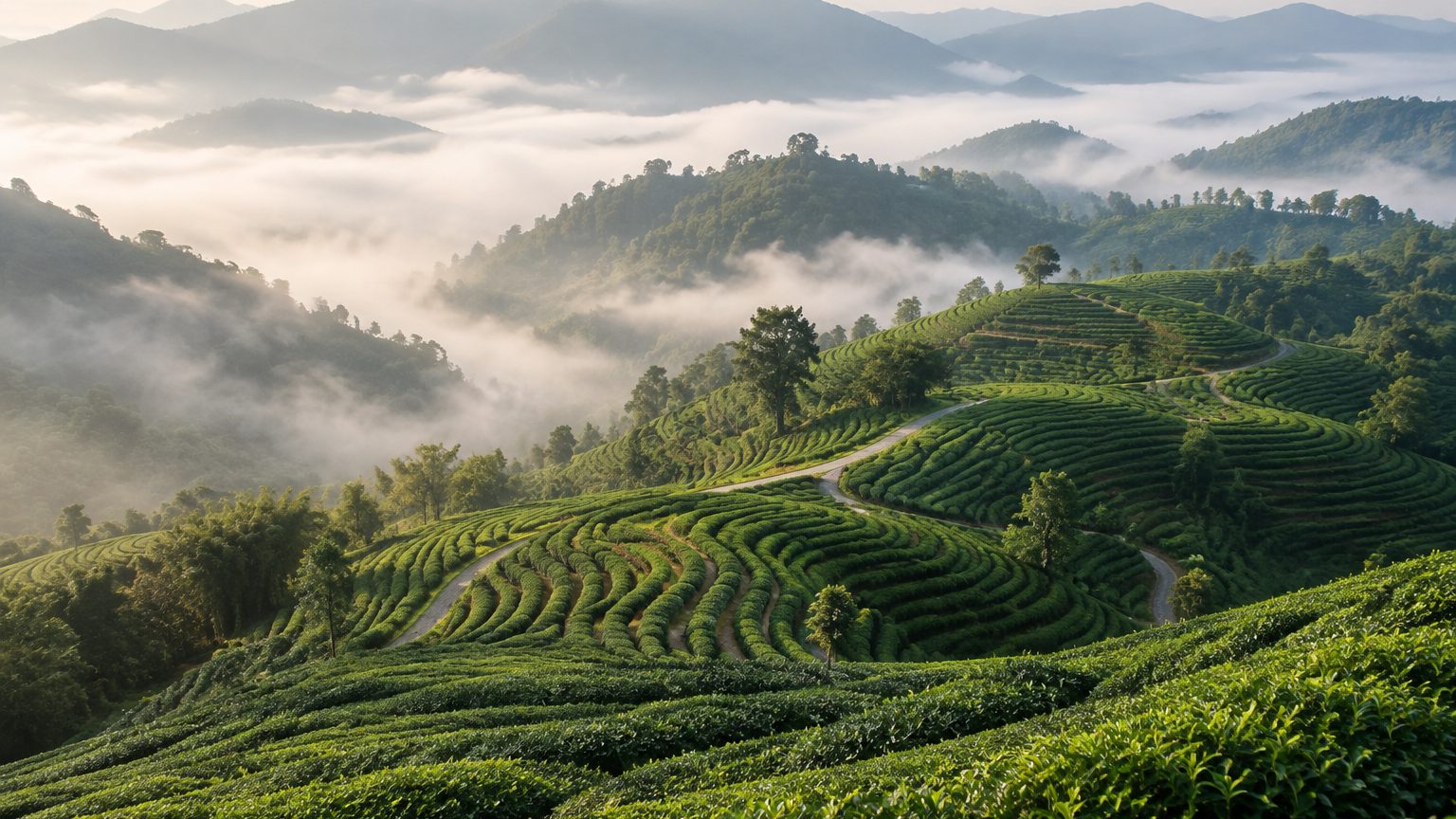
Why the map decides the cup
Ask for a green tea and you will get something different from every province that grows one. Altitude, cultivar, harvest window and the local processing habit give each region a signature the cup can read, which is why a sourcing desk's first real asset is not a warehouse but a map of who grows what well. The desk maintains a network of partner gardens and packing facilities across six Chinese provinces, matched to the categories those regions are known for, and adds Japanese greens and origin-imported black teas through compliant channels for blending programs. No single facility covers this range, and none claims to: the network is the capability. Every lot record states its origin and harvest window plainly, so what you approve as a sample is what arrives as bulk.
China by category: the six regions
| Region | What it grows | Lines in the catalog |
|---|---|---|
| Zhejiang | Pan-fired greens of the classic flat style; the Anji pale cultivar processed as green | Longjing, Anji white tea, food-grade matcha powder |
| Jiangsu | Curled pan-fired greens from the Lake Tai fruit-tea intercropping belt | Biluochun |
| Anhui | Strip greens of the Huangshan area and the Keemun black tea county | Maofeng, Houkui, Keemun |
| Fujian | The densest range: Anxi rolled oolong, Wuyi rock oolongs and smoked blacks, Fuding whites | Tieguanyin, Da Hong Pao, Lapsang, Jinjunmei, Silver Needle and the white family, jasmine scenting |
| Guangdong | Chaozhou single-tree oolongs and the ceramics belt that supplies gongfu ware | Fenghuang Dancong, tea set sourcing |
| Yunnan | Large-leaf blacks and the pu-erh mountains of the south-west | Dianhong, raw and ripe pu-erh, CTC base material |
Two Fujian notes buyers ask about: white tea is a Fuding-and-Zhenghe story, with the four grades from Silver Needle down to Shoumei all coming from that corner of the province; and jasmine tea is scented in Fujian and Guangxi using green tea base - the flowers travel to the base, not the reverse. Rock oolongs and the smoked black teas share the Wuyi mountains but not the same makers, which is exactly the kind of distinction the desk encodes when it shortlists a partner for your program.
Japan and origin imports
Japanese-style lines are sourced through Japanese channels and Sino-Japanese processing partners: steamed greens in the sencha and gyokuro styles, with the roasted-rice blend built on a green tea base. Food-grade matcha powder, by contrast, is a Chinese supply story - shade-grown tencha ground on stone or bead mills - which is why it prices differently from ceremonial Japanese material and why the desk is explicit about which one a program is buying. Origin imports cover the black tea classics that do not grow in China's network: Assam from India and Ceylon grades from Sri Lanka, both brought in through compliant import channels for blending, milk-tea bases and range completion. The Assam and Ceylon pages state what the desk can hold for those programs; the rest of the range is Chinese-grown.
How partners are screened, per program
A region is not a quality system - a facility is. The desk screens partners per program rather than trusting a permanent badge list, and the screening is written down: what the facility is licensed to produce, how it handles leaf, what its lab and testing access look like, whether records support traceability. The full dimension list is set out on the factory audit page, and the cupping and lab work that follows sits under quality control. In practice a shortlist for a new program runs like this: cup candidate lots first, shortlist the makers behind the cups that fit, verify the facility against the audit dimensions, then lock a golden sample and start bulk against it. Partners who clear that loop become the standing bench for their category; partners who drift are retired without ceremony.
Season windows across the network
The regions do not harvest together, and the calendar is part of the network's value. Green teas are a spring event: pre-Ming Longjing is picked before early April, Biluochun follows in the same window, and the best material is committed within weeks. Fujian whites also center on spring; Anxi oolongs run spring and autumn; Wuyi rock teas reach market after summer roasting; Yunnan blacks and pu-erh stretch across more of the year. For a buyer this means the network is planned against your launch date, not discovered when a supplier happens to have stock - the calendar logic is laid out under MOQ and lead time. If your market needs a fresh green tea landing in a fixed month, the desk books the spring window backwards from that date and tells you plainly if the window cannot hold.
What the map means for your program
Three practical consequences. First, category fit is not negotiable at the margin: a request for Fuding-style Silver Needle grown in Yunnan will be answered with what Yunnan actually makes, or a plain no. Second, blending programs can mix origins legitimately - a breakfast blend with Assam strength and Keemun perfume, a genmaicha-style blend, a CTC base with Dianhong lift - because the desk coordinates across the network rather than selling one facility's output. Third, traceability is the union of the lot record and the map: origin, harvest window, processing notes and packing date all land on the paper. If you want to see how the map converts into samples, send your cup profile and market through the quote form and the desk will return a shortlist with the reasoning in writing.