
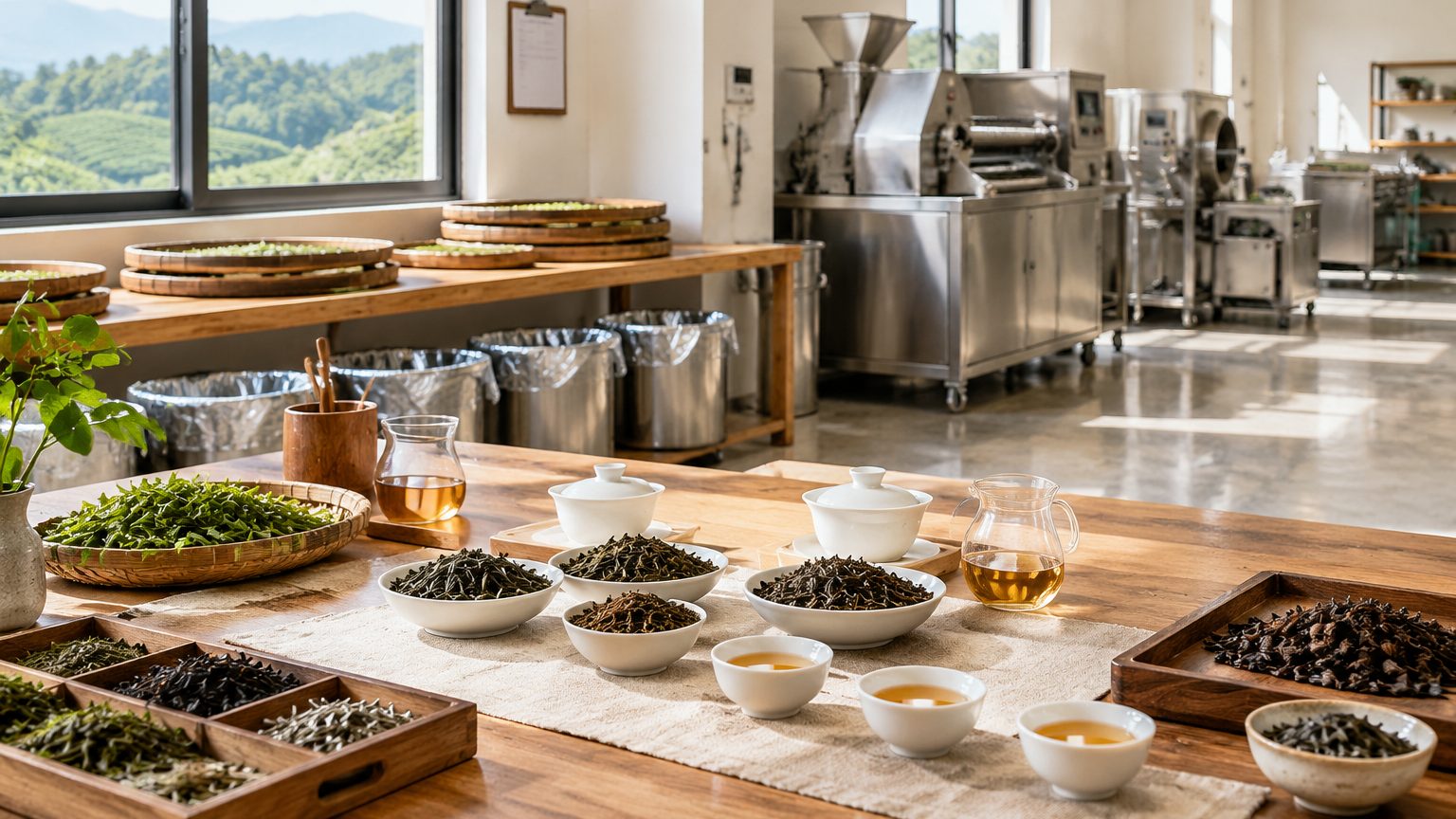
What an audit is here, and what it is not
Camellane owns no factories, and this page is not a tour of one. It is the list of dimensions the desk screens partner gardens and packing facilities against before a program's bulk is confirmed - the questions that separate a facility that can hold a food program together from one that merely owns a roaster. The checks are typical for the category and are confirmed per facility during audit: a white tea packer in Fuding and a pu-erh pressing line in Yunnan answer the same six questions with different, verifiable answers. Nothing here is a promise about any particular building; it is the method, written down so you can ask the same questions we do.
| Dimension | Core question | What is recorded |
|---|---|---|
| Food-grade licensing | Registered for food, with scope covering this product? | License and registration copies in the program file |
| Hygiene zones | Does leaf flow stay one-way, clean to finished goods? | Zone walk notes, physical and procedural findings |
| Leaf handling | Are wither, fix, roll and dry setpoints real and logged? | Process control notes per step |
| Metal detection | Working detector, tested and logged per shift? | Test-piece records, foreign-body registers |
| Lab access | In-house benches or an accredited third-party lab on call? | Panel scope, retained-sample practice |
| Record keeping | Can a carton be traced to its input lots in an hour? | Batch numbering, traceability chain |
Dimension one: food-grade licensing
The first gate is boring and decisive: is the facility registered and licensed to produce food, and does its license scope actually cover the product in your program - tea processing, scented tea production, blending, packing? A facility can be superb at one step and out of scope at another, and an exporter's paperwork is only as solid as the producer registration behind it. For US-bound programs the desk also confirms that the producing or packing facility holds a current FDA food facility registration, and for other destinations reviews the local production licensing picture with the exporter. Licenses are collected as documents, not descriptions, and they sit in the program file next to the certification chain your channel will ask for.
Dimension two: hygiene zones and the flow of leaf
Tea processing is a dry, low-risk food operation, but zoning still decides whether foreign material and cross-contamination stay out. The audit walks the flow: raw leaf in, withering and fixing, rolling, drying, refining, blending, packing out - and checks that the direction of travel does not fold back on itself. Specific points: separation between raw green leaf reception and finished-goods areas; screens on doors and windows against dust and drifting material; floor and equipment cleaning routines that remove tea dust before it becomes rancid residue; dedicated storage for packaging materials away from processing fumes; and clearly separated zones for any strongly aromatic work, because jasmine scenting next to an open green tea line would season it whether anyone planned to or not. The desk notes what is physical (walls, one-way flow) and what is procedural (schedules, logs), and both are recorded.
Dimension three: leaf handling and process control
How a facility touches leaf tells you how your lot will taste. The checks at parameter level: how withering spread depth and duration are set and watched; whether fixing temperature and time are instrumented or judged by eye; how rolling and shaping pressures are set per grade; how drying end-points are decided; and how refined and blended teas are held before packing - covered, off the floor, away from odor sources. For pu-erh programs the same lens covers the wet-piling room and the pressing line; for scented programs, how flower rounds are timed and cleared. None of this requires the facility to be modern; it requires the controls that exist to be real - dials that work, logs that are filled in, and staff who can say what the setpoints are without checking with the owner first.
Dimension four: metal detection and foreign body control
Metal detection at packing is the single foreign-body control the desk treats as near-mandatory for retail-packed programs, and it is checked as a working process, not a plaque on the wall: test pieces passed through at the start and end of each shift, rejection confirmed and logged, sensitivity checks documented. Around it sit the supporting controls - sieves and magnets on refining lines, sieve mesh records, knife and blade controls, glass and hard plastic registers in packing areas, and a written response when the detector rejects. For bulk-only programs going to a buyer who repacks, the question shifts to what your downstream line requires, and the desk confirms that in writing before the order - the practical frame is in the audit checklist note.
Dimensions five and six: lab access, records and traceability
Facilities vary in whether they run their own benches or send samples out, and both answers can pass. What the audit checks is access and habit: does the facility test moisture and basic physical parameters per batch; does it have a standing relationship with an accredited third-party laboratory for pesticide, heavy metal and microbiology panels; are samples retained from each production run; and can it produce last season's reports on request rather than promising to generate them. The desk's own layer on top is the per-batch third-party panel issued in the buyer's name, described under quality control - the audit confirms the facility can support that flow, not that it replaces it.
The last dimension is paper, and it is the one that decides how a problem gets solved. The checks: production records linking a packed lot to input lots; batch numbering that survives onto cartons and documents; retained samples stored against each batch number; cleaning and maintenance logs; and, where the program claims it, the ability to trace a finished lot back to origin area and harvest window - the chain that turns the origin network from a story into a document. A facility that can answer "which three batches fed this carton, and where are the retained samples" in under an hour is a facility the desk can defend in front of your auditor or your customer.
How the results reach you
Audit outputs are written summaries of these six dimensions per facility, plus the documents behind them, shared at the level your program needs - many buyers receive the summary and the license copies; some run their own visit on top, which the desk arranges. Findings are stated plainly, including the ones a facility fails, because a shortlist that hides its rejects is not a shortlist. If you are scoping a program and want the verification done before samples ship, put the channel, market and quantity on the quote form and the desk will return the shortlist with its screening basis in writing.