
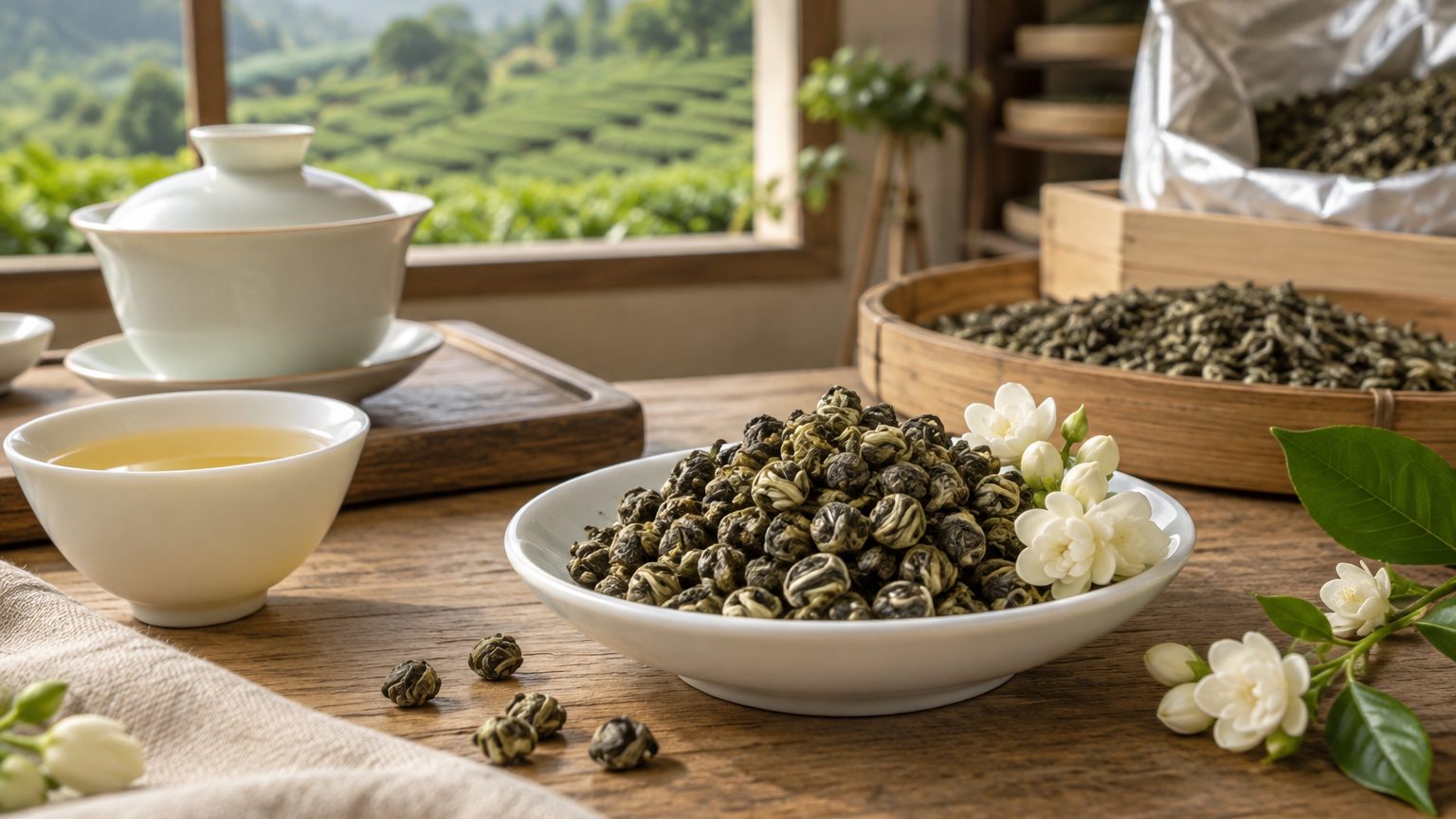
A garden planted between fruit trees
The name means green snail spring, after the tight spirals the leaf rolls into. The gardens sit on Dongting mountain beside Taihu lake near Suzhou in Jiangsu, and what makes the terroir unusual is the planting: tea rows run between fruit trees - loquat, plum, peach - in the traditional intercropping the trade calls cha-guo jianzuo. The leaf buds early in spring, while the trees are still flowering, and the cup carries a floral, fruity fragrance that needs no flavoring; it comes from the cultivar, the lakeside climate and the company the tea keeps in the rows. That natural perfume is why Biluochun is often called the most fragrant of China's green teas, and why it sits one step from Longjing on most premium shelves - the side-by-side comparison is one buyers ask for by name.
From one bud to a tight spiral
Picking is early and small: a bud and a young leaf, sometimes a bud alone for the top grades. The leaf is pan-fired, but the shaping is the opposite of Longjing - instead of being pressed flat, Biluochun is rolled and curled into tiny spirals dense with white down. Rolling is the step buyers underestimate: it decides whether the leaf brews evenly or shreds into fannings, and the difference between careful curling and rough tumbling is visible after one infusion. The rolling and shaping guide walks the common defects. After shaping, the tea is dried low and slow, sieved to grade and packed quickly - a tea this delicate does not improve with waiting.
The cupping sheet and brew reference
| Factor | Reference profile |
|---|---|
| Dry leaf | Tight small spirals, silvery white down, even size |
| Liquor | Tender green, bright, clear |
| Aroma | Floral and fruity, fresh - a jasmine-and-stone-fruit lift with nothing added |
| Taste | Fresh, brisk, sweet, delicate body |
| Wet leaf | Whole small leaves, buds intact, soft green |
| Brew parameter | Reference |
|---|---|
| Ratio | 3 g per 150 ml |
| Water temperature | 80°C |
| Steep time | 2-3 minutes |
Eighty degrees is the line that protects the fragrance; hotter water scalds the perfume and pushes out bitterness. The parameters go on the lot sheet so menus and labels can print them as they are. For iced or cold-brew service, the same leaf over a longer cold steep keeps the fruit and loses the bite.
What bud density and down tell you
Grade in Biluochun is mostly a story of bud density and down. Top grades are nearly all bud, heavily furred, tightly curled and uniform in size; down the scale the spirals open, the color deepens and the cup shifts from perfume to plain green freshness. Neither is better in the abstract - a hotel potting tea by the liter wants the steadier, plainer cup, while a 30 g gift tin justifies the bud-heavy lot. The desk prices grades as separate programs with separate reference MOQs, states picking standard and bud share on the lot record, and cups candidates against the season reference so the bag matches the sheet. On the green tea desk this line plays the fragrance card; the shelf story writes itself.
Where Biluochun earns its shelf
Biluochun suits buyers who sell freshness as the story. Premium retail takes the bud-heavy grades in small pouches and tins; tea houses pour it beside Longjing and let customers compare; e-commerce programs use the name recognition with content explaining the fruit-tree intercropping. It is less common in high-volume foodservice, because delicate cups get lost behind buffets and milk programs - the desk steers those accounts toward sturdier greens, usually pre-rain Longjing or Maofeng, and says so before the sample round rather than after a disappointing pot.
Packing and private label notes
The tiny curled leaf and the volatile perfume make packing decisions matter. Bulk moves in foil-lined bags inside cartons; retail formats are small - 25 g, 50 g, 100 g pouches and tins - because the tea is bought as a treat, not a pantry staple. Labels follow destination-market rules, artwork is handled through packaging options, and MOQs for private label packs follow the standing reference ranges, confirmed in writing per program. Tins beat pouches on shelf life for this line; the down marks the pack if the leaf is handled roughly in filling.
What buyers check before ordering
- Down and curl integrity: heavy white down, tight spirals, little breakage in the bag.
- Aroma on the dry leaf: floral and fruity, never flat or papery.
- Cup at 80°C against the reference: briskness first, then the fragrance that follows.
- Packing dates and storage history - delicate greens fade fastest.
- Lab panel per batch, scoped to your destination market.
Send the brief to the desk with your grade and pack in mind, and a written sample plan comes back - bud-heavy hero and workhorse grade side by side, so the program decision is a tasting, not a guess.