
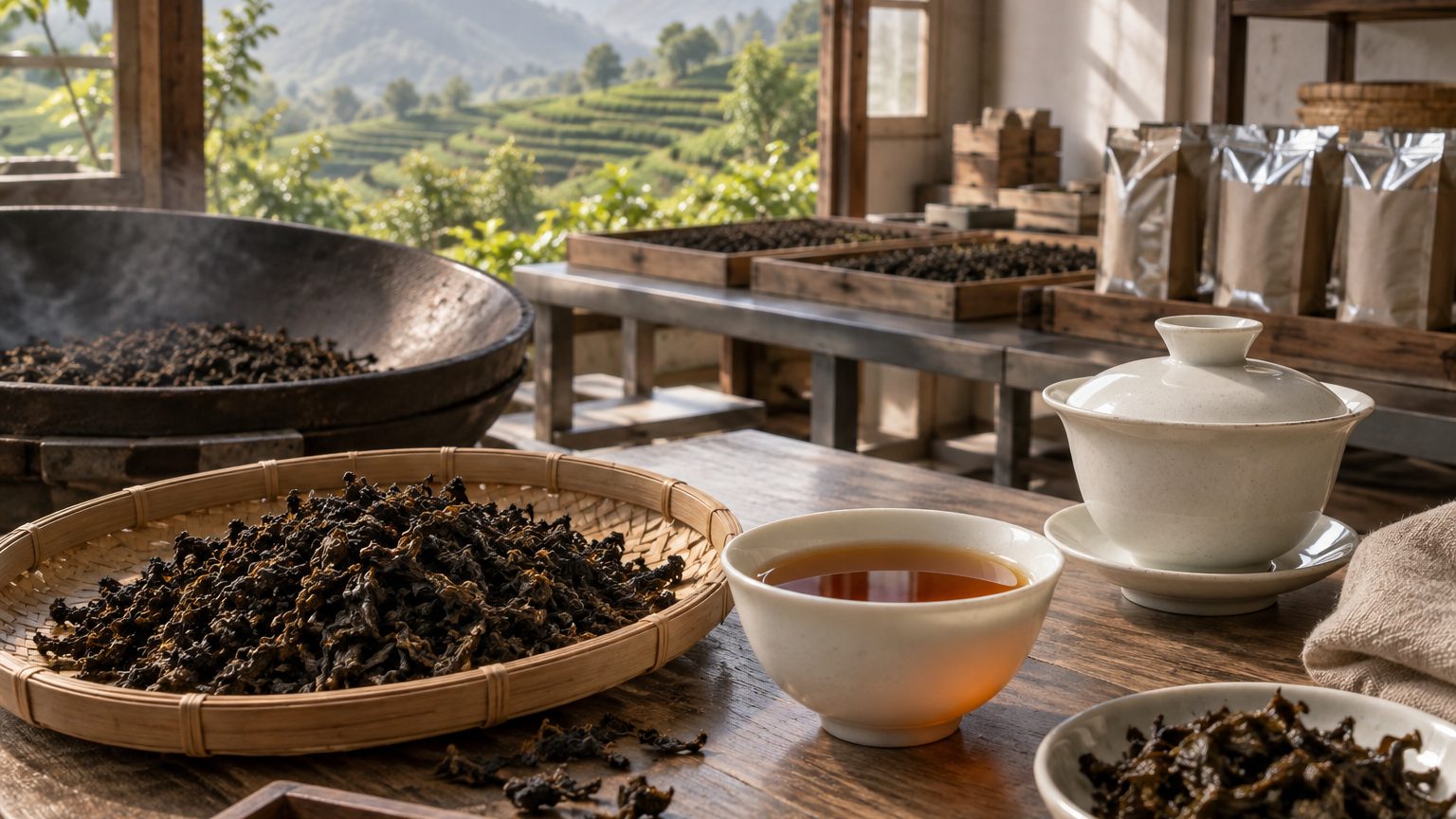
What yan yun means on a spec sheet
Rock tea is judged by a word no lab instrument captures: yan yun, the rock rhyme. Practically it is a sensation - a mineral firmness in the middle of the palate, a swallow that finishes sweet instead of drying, an aroma that returns minutes after the cup. It comes from the terrain: the Wuyi range in northern Fujian, where tea gardens sit between weathered cliffs on thin, rocky soils, and from charcoal roasting that binds the aromatics into the leaf instead of sitting on top of it. When the desk writes a Da Hong Pao lot sheet, yan yun is what the reference sample has to demonstrate in the cup - if a lot tastes roasted but hollow, it fails the check even if everything else looks right. Buyers comparing offers across suppliers should treat that term as a cup test, never a label claim.
How it is made
Rock oolong runs the longest processing chain in the tea world. Leaf is picked as mature shoots, sun-withered, then shaken and bruised through the night so the edges oxidize in patches - the partial oxidation that defines oolong. Fixing stops it, rolling twists the leaf into tight strips, and then the step Wuyi is famous for: roasting over charcoal embers, in repeated passes with long rests between, at medium-to-full fire for this line. Roasting does three jobs - dries the leaf to shelf stability, rounds the green edges into toast and fruit, and lays down the depth that lets the tea rest for months before it drinks its best. The roasting guide and charcoal roasting notes cover what each fire level changes. Fresh-roasted lots are often sold too early; the desk holds stock so lots reach you after the fire has settled.
The cupping sheet
| Factor | What the reference shows |
|---|---|
| Dry leaf | Dark, tightly twisted strips, faint roast bloom |
| Liquor | Orange-red, clear, bright |
| Aroma | Roast and ripe fruit over a floral lift |
| Taste | Mineral core, smooth body, sweet returning finish |
| Wet leaf | Brown-red edges, soft strip, even fermentation |
Brew it gongfu: 7 g in a 110 ml gaiwan at 95-100°C, quick pours, six or more infusions from one charge. For foodservice the economics are the point - a single charge serves a tasting flight, so cost per service is lower than the per-kilo figure suggests. The same parameters print on retail packs under the private label program so the customer brews it the way it was specced.
Grades and the honesty around the name
Da Hong Pao is the most recognizable name in rock tea, and that fame attracts loose usage. At the top sit single-bush and limited-lot teas from the core rock valleys, priced accordingly and mostly destined for tea houses and collectors. Beneath them, well-made composite blends - and blends are traditional in Wuyi, not a scandal - carry the profile at working prices. Below that sit lots from outside the core scenic area, and outside Wuyi altogether, which can still drink well but lack true yan yun. The desk's rule is stated origin on every lot sheet: core or outer Wuyi, blended or single material, roast level, and the reference sample the bulk must match. If a program needs the profile at a budget, the desk says so and matches the grade to the budget openly - that conversation happens before the order, through the procurement process, not after it.
Who buys it, and where it sells
Tea houses and professional channels are the natural home: rock tea rewards gongfu service and a customer who asks questions. Hotels and restaurants use mid-roast lots as a premium pot tea with real body that survives food pairing. Retail brands find Da Hong Pao a strong hero SKU for Chinese tea assortments - the story is known, the dark leaf ships sturdily, and the shelf life beats green tea by a wide margin. Gifting programs take the gift-box route with the gift box program where organic material is required. Buyers building an oolong wall should read the oolong category page and the Tieguanyin comparison - the two anchor opposite ends of the oolong shelf.
Seasonality, roast and buying calendar
Wuyi picks in spring, but rock tea reaches market after roasting and rest - the drinking year runs behind the harvest. Autumn-processed lots surface over winter; deep-roast material often drinks its best several months after firing. For buyers this inverts the usual green-tea urgency: the calendar risk is not missing the harvest but buying lots too fresh, when the fire still masks the leaf. The desk holds roasted stock through its settling period and states roast date and rest time on the lot record. Storage is forgiving - cool, sealed, away from odors - and guidance sits on the grading and storage page.
What to check before bulk
- Origin statement on the lot sheet: core, outer or blended Wuyi - plainly worded.
- Roast level and roast date; whether the fire has settled or still dominates.
- Cup against reference at 7 g / 110 ml: mineral core present, finish sweet not ashy.
- Wet leaf check: even oxidation, pliable strips, no green patches.
- Lab panel per batch for the destination market; documents per program.
Send the roast level and market to the desk, and sample alongside Rougui and Shui Xian to hear the whole Wuyi range in one sitting.