
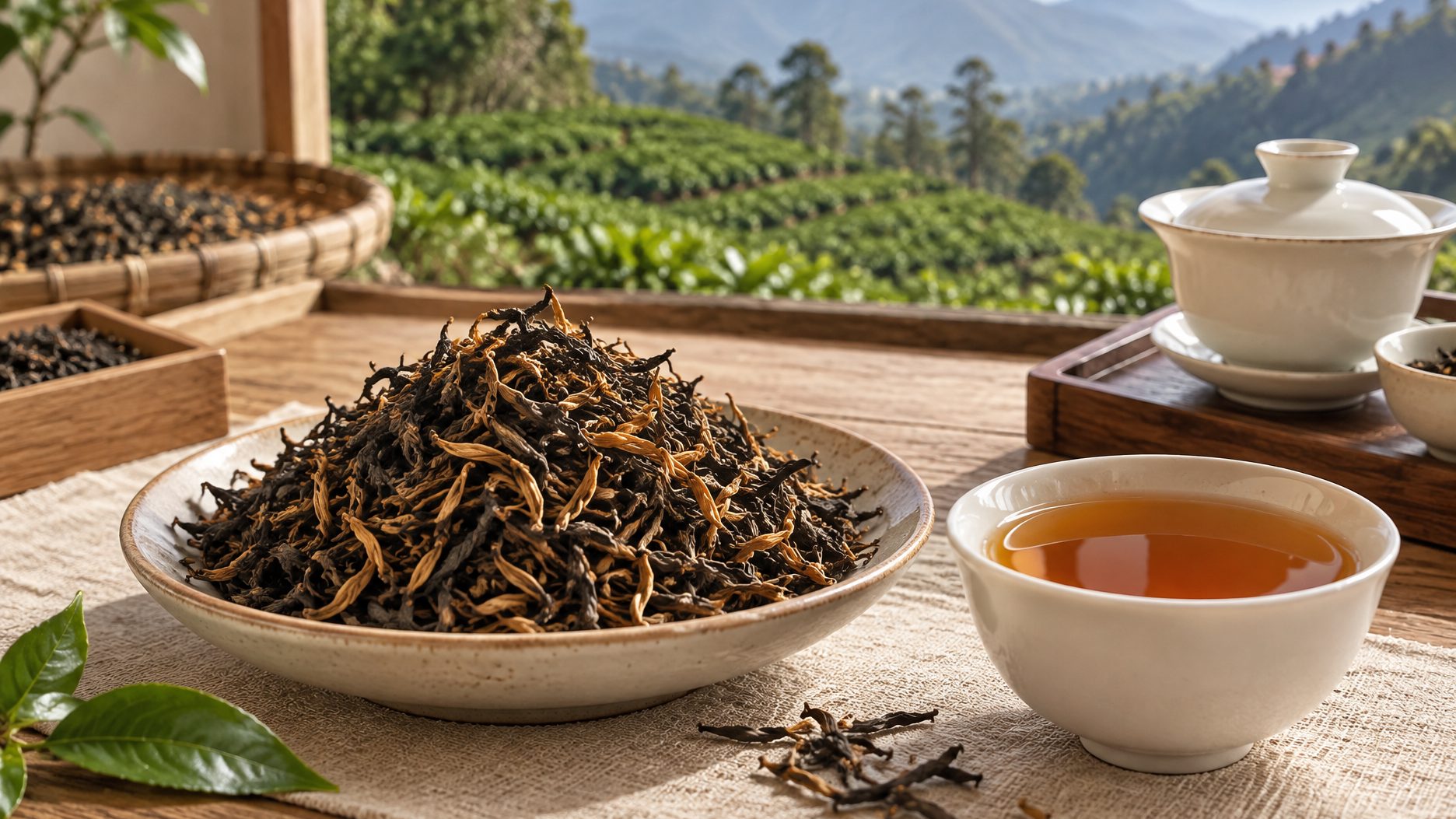
Origin: the large-leaf belt of Yunnan
Dianhong grows in Yunnan's western highlands, with Fengqing as the county most buyers will have heard named, and neighboring counties supplying material in the same family. The region's tea trees are large-leaf types - genetically broader leaves than the small-leaf bushes of eastern China - and that leaf is what gives the line its body: thicker liquor, deeper red color, and a sweetness the trade describes as honey or sugar-cane rather than floral. Elevation and old tea-growing culture matter here in practical terms: material is available across more of the year than the single-window mountain teas, which makes Dianhong one of the easier black lines to hold consistent at program scale. Origin records for each lot follow the structure of the desk's black tea program generally.
Processing: from large leaf to strip grades and golden tip
The making is orthodox black tea: wither, roll, oxidize fully, dry. What separates grades is the material going in and the care of the finishing. High grades are picked finer and show a high share of golden tips - the buds and young leaves covered in down that reads as gold against the dark strip. Standard grades use broader leaf, give a stronger, more tannic cup, and cost structure that suits blending. Nothing is smoked, and unlike the broken CTC style the leaf stays in strips, which is why Dianhong reads as handsome through a pack window while still extracting hard. For buyers torn between the two families, the strip-versus-granule trade-off is the same one described on the CTC line page.
The cupping sheet
| Factor | Golden-tip lot | Standard strip lot |
|---|---|---|
| Dry leaf | Black strips, abundant golden tips | Darker strips, few tips |
| Liquor | Deep red, dense, bright | Deep red, strong |
| Aroma | Honey, sweet potato, caramel-sugar | Honeyed, more astringent edge |
| Taste | Sweet entry, thick body, mild strength | Strong, brisk, built for milk |
| Wet leaf | Red-brown, soft, even | Red-brown, coarser cut |
Both columns cup within the same five-factor frame the desk applies to every black line, and the choice between them is a program decision, not a quality verdict: golden-tip lots sell the pack, standard lots carry the blend.
Brew parameters, including for milk
| Parameter | Reference |
|---|---|
| Leaf to water | 3 g / 150 ml |
| Water temperature | 95-100°C |
| Infusion | About 3 minutes; longer for milk service |
| Milk tea adjustment | Heavier dose or longer steep; verify by cup, not by rule |
Dianhong stands milk well, which is why beverage brands shortlist it next to CTC: the honey note survives sweetened dairy, and the strip form gives a cleaner cup than broken grades at the same strength. Dialing the exact dose for a signature drink is a blending exercise, not a guess - the blending program exists for precisely that, and the ratio logic is laid out in the brewing ratio guide.
Grades and program fits
Audience by audience, roughly as programs actually order it. Bubble-tea and beverage brands run Dianhong as a premium milk base when the menu wants a named origin on the label - the bubble tea program page shows how batch lock works for that use. Hotels and cafes pour it as the house black: strong enough for breakfast service, honeyed enough to drink plain. Retail private label uses golden-tip lots where the pack window does the selling. E-commerce sellers position it as the accessible Yunnan story - recognizable, photogenic, and easier to explain than a mountain-single-lot narrative. For a second Chinese black on the same wall, most programs pair it with Keemun for contrast; the two are compared in the Keemun vs Dianhong note.
Blending, private label and consistency
The line's real job in most programs is consistency: the same red cup, month after month, across harvest variation. That is a blending discipline - golden samples held as the bar, incoming lots cupped against them, recipes adjusted within the approved material set before anything ships. The mechanics are written up in the blend consistency guide, and the commercial spine - reference samples, written offers, per-batch lab panels - runs through the desk's standing process. Private label follows the usual ladder: bulk at one MOQ tier, retail packs at another, with destination-market labels produced per program.
Seasonality and buyer checks
Yunnan harvests across more of the year than the single-window Fujian mountain teas, but spring still sets the reference cup - early material is finer, later material stronger. Programs therefore lock the spring reference and let the blend hold the profile through the year. Before bulk, the desk's checks are the standing list: dry leaf and tip share against the approved sheet, the five-factor cup against the golden sample, moisture and pack integrity, and the per-batch lab panel issued in your name. None of it is exotic; all of it is written down, and the quote form starts the written trail with a sample plan.