
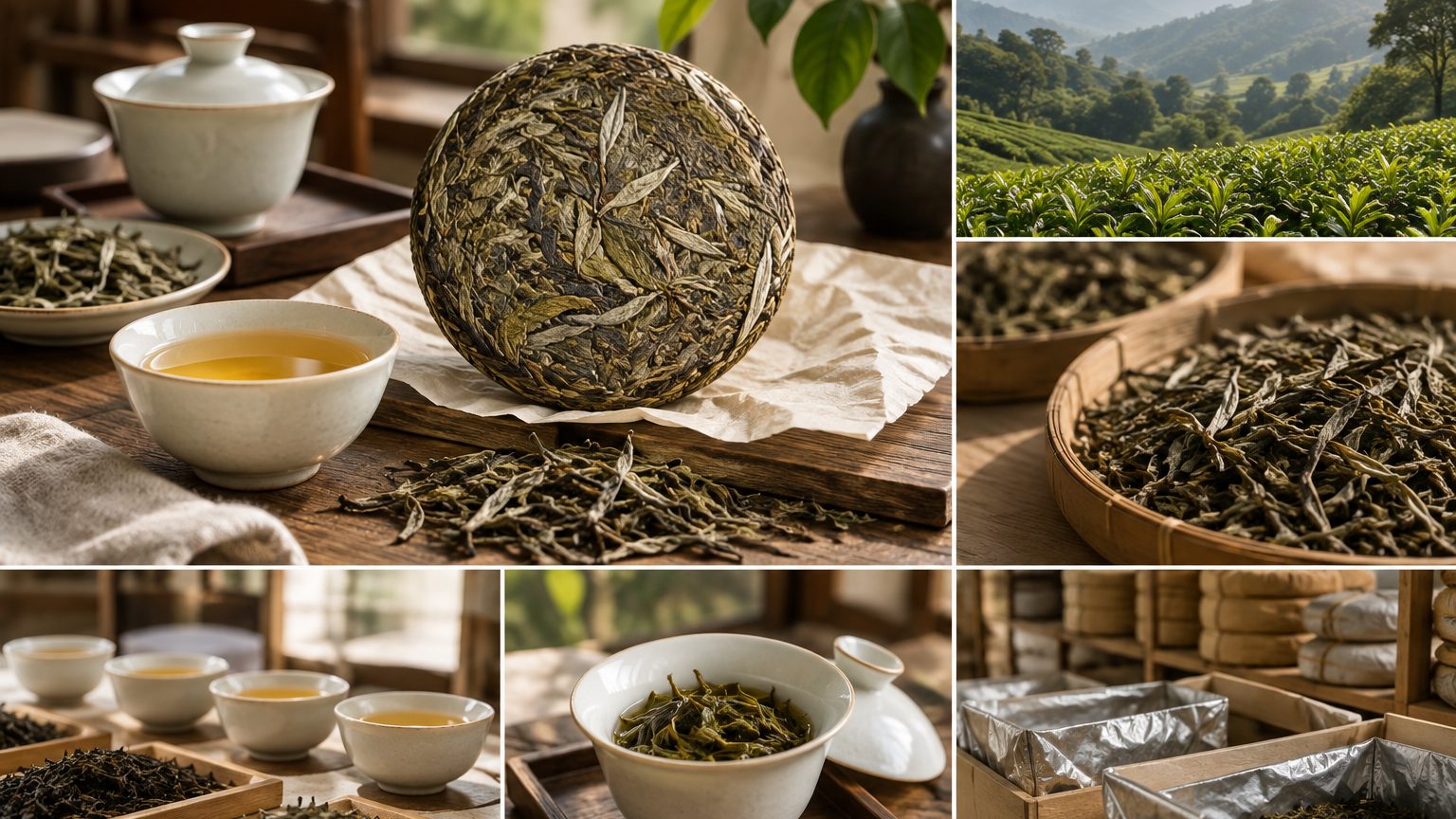
What sheng is: sun-dried leaf under the press
Raw pu-erh is green tea's wilder cousin, classified in the trade as dark tea for where it is headed rather than where it starts. Yunnan leaf - from the broad-leaf stands of Xishuangbanna, Lincang and the Pu'er districts - is picked, kill-fixed, rolled and then dried in the sun rather than over heat. That sun-dried maocha keeps a residual microbial life no oven-dried green carries. It is steamed soft, pressed into cakes, dried again and wrapped in cotton paper, and from that day the tea evolves. Young sheng pours yellow-green with a bright bitter edge, camphor-floral aroma and a long returning sweetness the trade calls hui gan; with years of decent storage it deepens toward amber, honey and dried fruit. The two poles and the road between them are the whole pitch, and the raw versus ripe guide walks them side by side against the wet-piled counterpart.
Terroir you can argue about
More than any other line here, raw pu-erh is bought by place. The same process over different Yunnan districts and different stands of trees gives recognizably different cups - one region's lifted floral bitterness, another's deeper, sweeter wood. The desk does not oversell this: village-level pedigree is a premium market with premium prices and its own verification problems, and many programs do perfectly well on solid district-level material stated plainly. What every program gets is the same discipline - origin named on the lot record, samples cupped before commitment, and the reference sample governing reorders. If a buyer wants to build a range of regional shengs, that is a conversation about how many references to hold, not a brochure promise. The honest framing wins more repeat orders in this category than any legend does.
The cupping sheet, young sheng
| Factor | Young raw cake | What the buyer watches |
|---|---|---|
| Dry leaf | Green-black to silver-green cords, buds visible | Red-brown scorched leaf means firing faults |
| Liquor | Yellow-green, clear, bright | Dull color suggests stale or heat-damaged stock |
| Aroma | Cool floral, camphor, hay honey | Smoke beyond a whisper means sloppy drying |
| Taste | Bitter-sweet arc, quick return, salivation | Stuck bitterness with no return is a bad sign |
| Wet leaf | Green-brown, elastic, mostly whole | Fragmentation means rough handling |
Cupping follows the five standard factors (GB/T 23776 method) against the season reference, with the note that young and aged material are judged on different expectations - the sheet states which is which.
Brew parameters
| Service | Dose | Water | Note |
|---|---|---|---|
| Gongfu, young sheng | 5-7 g / 110 ml | 95-100°C | Fast pours; extend with steeps |
| Pot, general | 4-5 g / 150 ml | 95-100°C | 2-3 minutes to start |
| Aged sheng | 5-7 g / 110 ml | 100°C | Quick rinse, then pours |
Young sheng punishes over-steeping with raw bitterness, which is why gongfu parameters travel with every sample. Aged sheng is more forgiving and takes a rinse like ripe does. On-pack directions follow the format sold.
Aging potential, stated honestly
The reason anyone presses sheng instead of drinking it loose is the aging curve, and the desk's position on it is deliberately unromantic: sheng can round beautifully over years, but only the whole way - cool, ventilated, odor-free storage, neither damp nor baked, in breathable paper. Humid shortcuts grow mustiness, not maturity; hot shelves just bake the green out and leave a flat middle. So the line sells on documents: pressing date and district on the lot record, storage conditions stated, and no wrapper poetry standing in for history. Programs that want aged character now can buy vetted older stock with its record attached, or blend young material forward knowingly. The mechanics live under grading and storage, and the long-form version in the cake storage guide.
Who buys raw cake
Tea houses are the core audience - sheng is a ritual tea where the rinse, the escalating pours and the table conversation are part of what the customer pays for, and the specialty channel page covers that fit. Specialty retailers merchandise the bing as an object and lean on regional variety to give the wall depth. E-commerce sellers do well with mini cakes and sampler sets that let customers taste the young-versus-aged gap cheaply. It is a poor fit for mass milk-tea counters, whose strength-first brief belongs to black lines; pushing sheng there usually produces a disappointed program. Corporate gifting takes engraved-sleeve cakes where the date stamped on the wrapper is the sentiment. The audience is narrower than ripe, and more loyal.
Pressing, wrapping and private label
Pressing runs weigh, steam, press, dry, wrap - cotton paper first, then printed sleeve or carton. The 357 g bing is the standard; mini cakes, tuocha-style shapes and bricks can be quoted as custom pressings with the tooling and lead time they honestly carry. Wrappers and neifei inserts print to your artwork; labels follow destination-market food rules. MOQ rides the desk's typical reference ranges per format - confirmed in writing per program - and the calendar consequences of custom pressings are set out under MOQ and lead time. Bring the district, the year and the market to the desk, and samples come back with their lot records attached.