
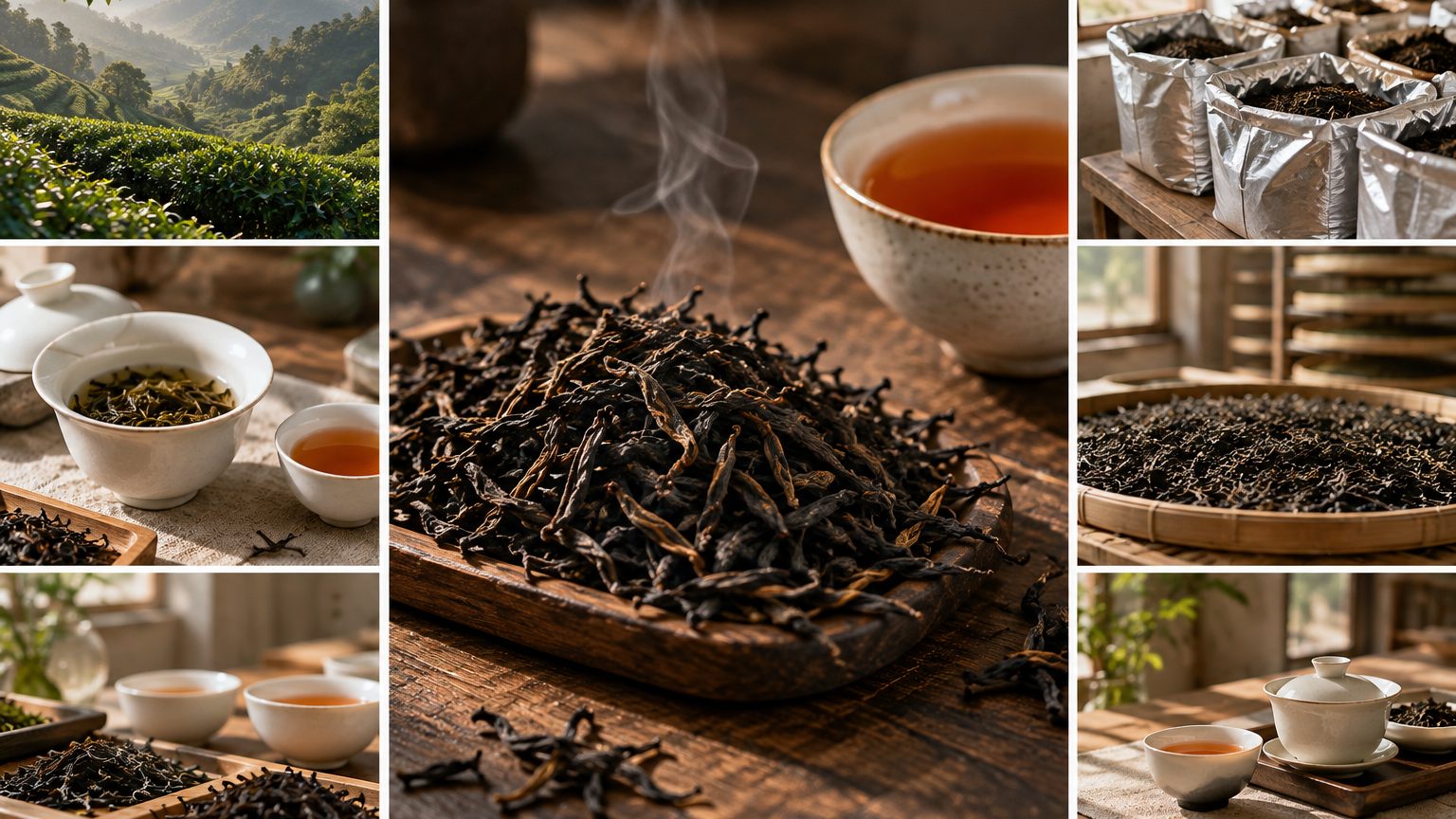
Where it comes from: the Tongmu Pass
Lapsang Souchong is the black tea of the Tongmu Pass, a narrow high valley inside the Wuyi Mountains of Fujian, near the Jiangxi border. The valley is steep, misty and cooler than the lowland tea belts; leaf grows slowly and carries the mineral, faintly resinous edge that buyers recognize as the lapsang signature. The trade name itself points at the material: souchong refers to the larger leaves of the original style, and the valley's tea identity is as tied to its geography as Keemun's is to Qimen county. The desk coordinates with partner makers across the Wuyi area, and every program file carries origin and lot records - the structure behind that is described on the origin network page.
Smoked and unsmoked: one tradition, two directions
Traditional Lapsang Souchong is finished over pinewood fires. After withering, rolling and full oxidation, the leaf rests above smoldering pine and takes on a smoke that survives years in the bag and announces itself the moment a pouch is opened. The modern unsmoked style skips the smoking step and lets the valley character speak alone: fruit, honey, a soft mineral close. That unsmoked family is also the line that later produced Jinjunmei, the bud-only premium of the same hills. Neither style is an upgrade of the other. Smoked goes to buyers who want a cup nobody mistakes for anything else; unsmoked goes to those who want a Wuyi black without the bonfire. The desk cups both side by side before any program commits, because the two do not substitute for each other on a shelf.
The cupping sheet
| Factor | Traditional smoked | Modern unsmoked |
|---|---|---|
| Dry leaf | Twisted black strips, bonfire nose | Black strips, clean nose, faint fruit |
| Liquor | Red-orange, clear | Orange-amber, bright |
| Aroma | Pine smoke over dried longan | Honey and fruit, no smoke |
| Taste | Smoky entry, longan sweetness behind | Soft, sweet, gentle mineral finish |
| Wet leaf | Red-brown pliable strips | Red-brown, even strips |
The five factors follow the standard evaluation frame the trade uses - dry leaf, liquor, aroma, taste, wet leaf - and every lot is cupped against its reference before it ships. What the sheet cannot carry is intensity: smoke depth varies lot by lot and season by season, which is exactly why samples precede bulk everywhere in this program.
Brew parameters
| Parameter | Reference |
|---|---|
| Leaf to water | 3 g / 150 ml |
| Water temperature | 95°C |
| Infusion | About 3 minutes, adjusted to strength |
| Service fit | Western pots, tasting flights, food pairing menus |
These parameters print on the lot sheet so your team, your customer's staff and the pack all agree. For gongfu service the same leaf works in short repeated infusions; for pairing menus the smoked style holds its own against smoked and charred dishes, which is why restaurants keep it on the list long after trendier cups rotate off.
Grades and how buyers choose
Grades run from foodservice lots - steady, forgiving in a thermos, easy to repour - up to small-lot material for tea houses, where valley character and finesse of smoke both cost more. The honest variable is smoke quality: a clean pine note sits behind the sweetness, while a rough acrid burn sits on top of it, and only cupping separates the two. Lots are selected by sample against the golden sample, and any substitution needs written approval - that rule is the core of the desk's quality control routine, and it is what keeps year-two cartons tasting like year-one approvals.
Where Lapsang Souchong sells
The strongest channels are the predictable ones. Specialty retail leads, because the story on the pack does real work at the shelf. Tea houses pour it gongfu, where the smoke softens across infusions and gives staff something to narrate. Restaurants build pairing menus around it - smoked dishes, charred meats, dark chocolate desserts. E-commerce gift programs use it as the distinctive cup in a black-tea lineup next to Keemun and Dianhong. For milk-tea bases, the desk says plainly: the smoked style is usually wrong for dairy-heavy drinks, and stronger, cleaner bases such as CTC or Yunnan Dianhong fit better. The black tea category page compares all eight lines if you are building a range.
Packing, season and buyer checks
Smoked styles hold aroma unusually well - the smoke itself is stable - but the leaf is an eager giver and taker of odor, so lots ship foil-lined and sealed, and retail formats follow the choices on the packaging options page, from kraft-foil pouches to gift cartons. Tongmu picking centers on spring, finished lots land after processing, and the calendar math of sampling, bulk and freight is laid out under MOQ and lead time.
- Cup against the approved reference: all five factors, not memory.
- Judge smoke character: clean pine behind sweetness, not acrid burn on top.
- Check moisture and pack integrity; confirm foil liners are sealed.
- Collect the lot record and the per-batch lab panel.
- Confirm the written offer; MOQ reference ranges bind only in writing.
When the profile is decided, send it to the desk and a sample plan comes back in writing.