
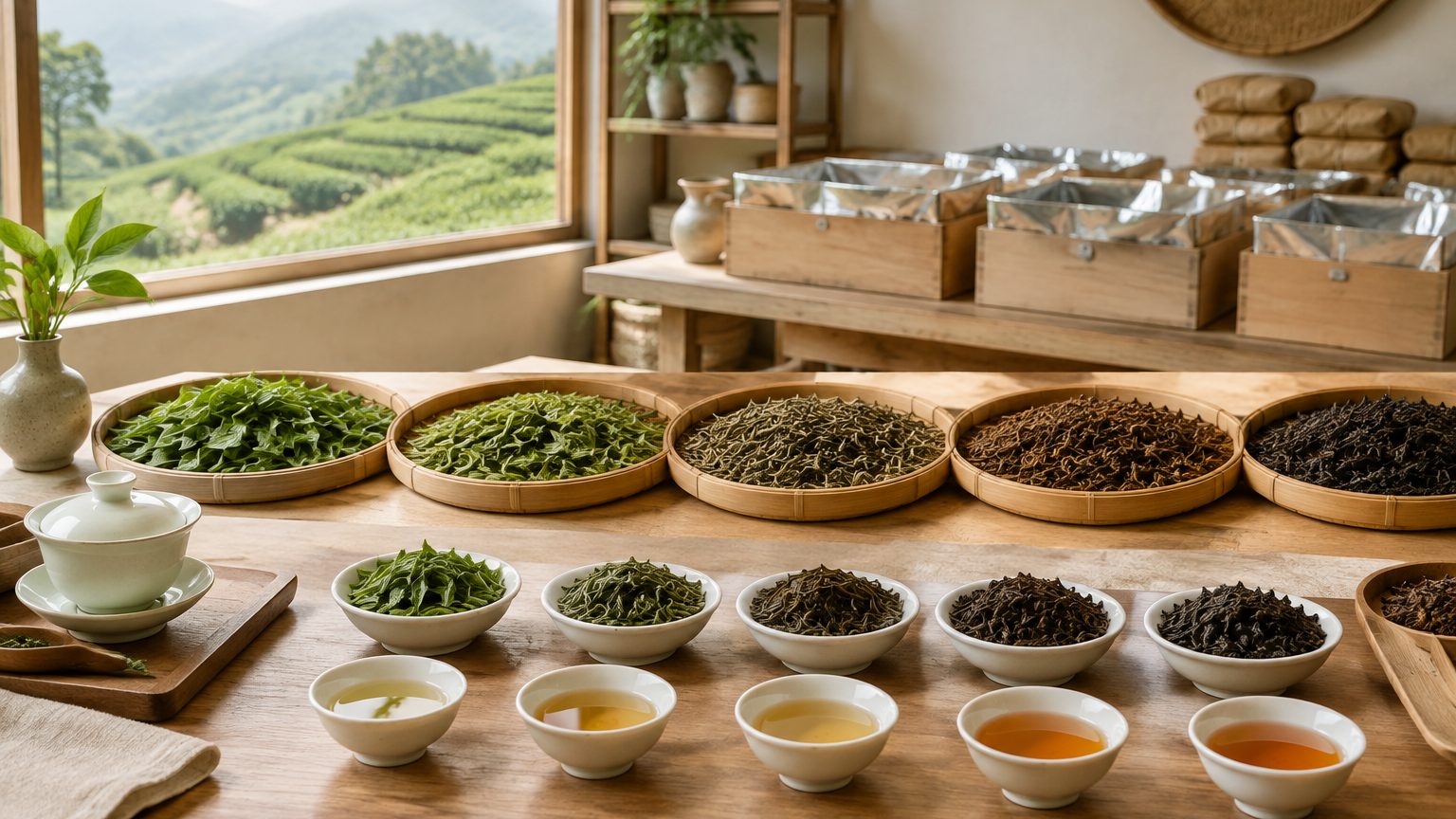
One plant, one spine, six personalities
Green, white, oolong, black and pu-erh all begin as leaves of the same species; what separates them is where along the spine the maker lets oxidation run and where it is stopped. That is why a sourcing desk talks about processing before it talks about price: the process is the product. The desk coordinates partner facilities that run this spine for their home categories - a Fuding white tea maker does not fix anything, an Anxi maker bruises and balls, a Keemun maker oxidizes fully - and the desk's job at this stage is to make sure the branch your program needs is the branch the facility actually runs, with the controls to prove it.
The spine, step by step
- Plucking. Standard decides the ceiling: single buds for Silver Needle and Jinjunmei, a bud and one or two leaves for most greens and whites, more mature leaf for pu-erh maocha and everyday grades. Season and weather set the starting chemistry before any machine runs.
- Withering. Leaf is spread thin and rested so it loses water and softens, and its aroma precursors develop. Depth, duration and air movement are the parameters; green and black share the step though black withers far longer.
- Fixing or oxidation - the fork. Green tea kills the enzymes fast, in a hot pan or a steamer, holding the leaf green. Oolong lets oxidation run part way through repeated bruising and rest. Black tea lets it run to full color development. White tea skips fixing and rolling both and dries gently. This single decision point creates the six categories.
- Rolling and shaping. Rolled strips, pressed flats, curled hooks or rolled balls - shaping breaks cells for extraction and sets the dry-leaf identity a buyer recognizes on sight.
- Drying. Baked, pan-finished, sun-dried or charcoal-finished to a stable moisture; end-point and firing style carry lasting flavor consequences.
- Refining. Farm leaf becomes program leaf: sieving to size, stem and stalk separation, winnowing of dust and fanning, grading into the lots a blend or pack actually needs.
- Blending. Batches are married for consistency - the core discipline of repeatable supply, covered in depth under blending and customization.
- Roasting. Where the style calls for it - rock oolongs, roasted Tieguanyin, smoked Lapsang - a firing pass sets aroma depth and shelf stability.
- Packing. Foil-lined cartons for bulk, retail formats beyond, sealed at the packing floor with date and batch - the step where packaging decisions take physical form.
Steps six to nine are where farm leaf is turned into something a buyer can reorder: the desk's cupping and testing layer sits on top of them, described under quality control, and the widely published sensory method behind the cupping - the five factors - is a public national standard method that facilities and the desk both work from.
How the fork plays out per category
| Category | Fixing or oxidation | Signature steps after drying |
|---|---|---|
| Green | Fixed quickly - pan-fired or steamed | Pan finishing for flat styles; scenting rounds for jasmine |
| White | Neither fixed nor rolled; slow wither and gentle dry | Optional ageing and cake pressing |
| Oolong | Partly oxidized via shaking and bruising | Ball rolling (Anxi) or strip roasting (Wuyi, Chaozhou) |
| Black | Full oxidation before drying | Grading and, for CTC, cut-tear-curl granulation |
| Pu-erh | Fixed then sun-dried as maocha; ripe adds wet piling | Steaming and pressing into cakes, then wrapping |
| Herbal | Not the tea plant - drying and cutting of herbs, fruits, grains | Blending and scented or flavored passes |
The pu-erh pressing line, as a variant
Pu-erh cakes run a compact variant of the spine worth knowing if cakes are on your list. Refined maocha is weighed to the cake weight, steamed soft in a perforated hopper, dropped into a cloth bag, shaped and pressed - stone-pressed the traditional way or machine-pressed for volume - then the bag comes off and the cake dries on racks before the cotton paper wrapper and a wrapper sheet go on. Weight accuracy, press pressure and drying to a stable moisture are the three controls that decide whether cakes survive transit and ageing without cracking or mustiness. The pressing line matters commercially because it is where bulk loose material becomes a distinct SKU with its own MOQ reference and its own sample cycle - cake samples are pressed small-run before any volume run is booked.
What the desk adds on top of the spine
The spine itself is the facility's craft; the desk's contribution is choosing the right branch, holding setpoints to the spec sheet, and documenting each step so the lot record tells the truth. Before bulk, samples from the trial run are cupped against the golden sample; during production, the desk tracks the process notes - wither times, fix temperatures, roast passes - into the lot record; before packing, inspection confirms leaf matches the approved reference and the pack spec is right, in the sequence set out under procurement process. If a step must deviate - a shorter roast, a later wither in humid weather - it is flagged to you in writing rather than discovered in the cup after arrival.
Reading the process from your own samples
Buyers who understand the spine can audit a sample on the bench without waiting for a report. Even dry leaf tells a story: consistent size and color point to careful refining; mixed grades in one bag point to skipped sieving. The wet leaf tells more - green tea leaves that brown at the edges were fixed late; oolong leaves that crumble were rolled too hard; a black tea with greenish stubble was under-oxidized. A five-minute infusion comparison against the golden sample catches most process drift before an invoice is paid, which is exactly why the desk ships reference samples first and holds bulk against them. To put a specific brief through this spine, describe the cup you want on the quote form and the desk will name the branch, the region and the sample plan.