
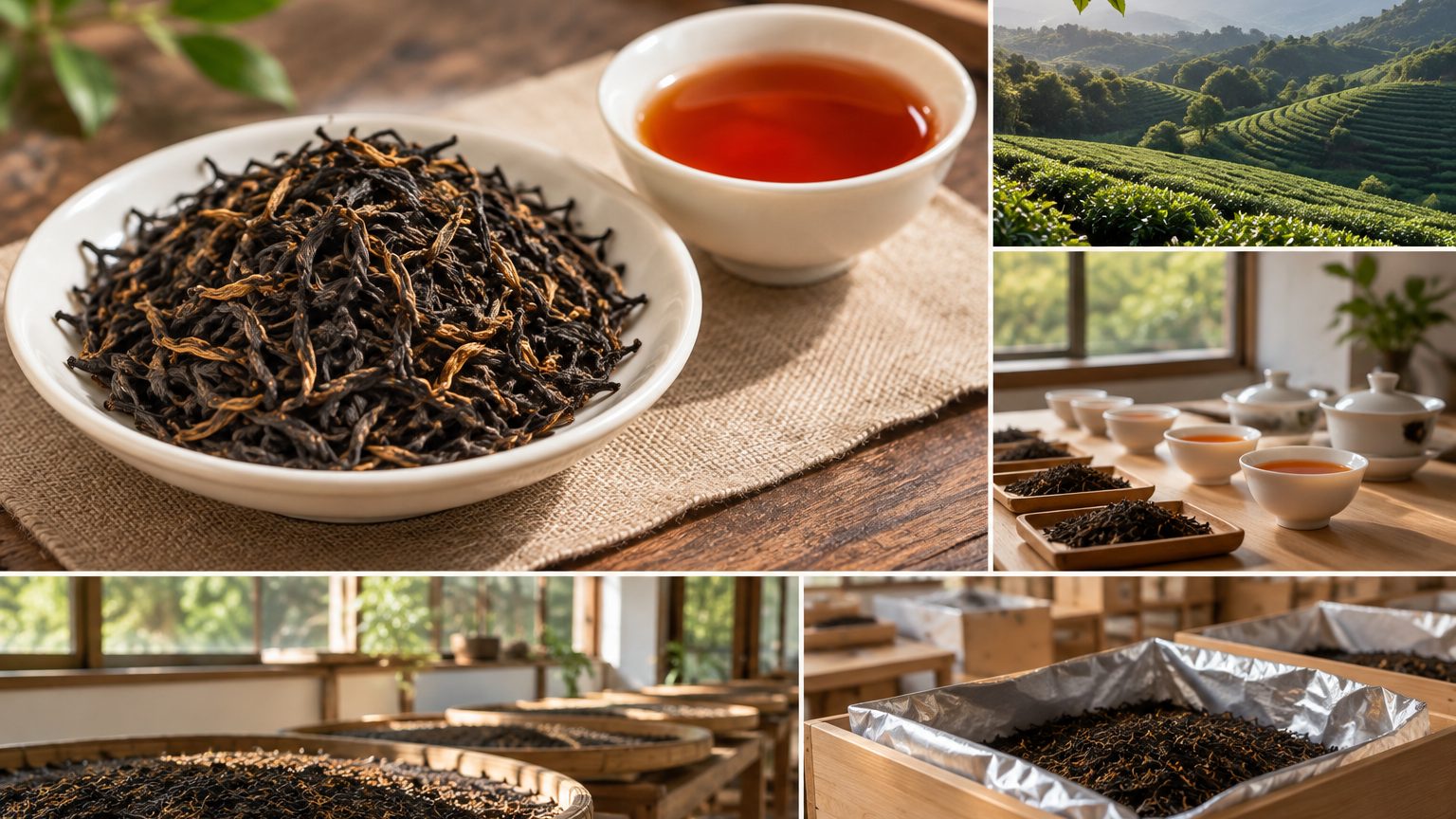
What the keemun fragrance actually is
Every famous tea has a term that compresses its quality, and Keemun's is the keemun xiang - the keemun fragrance: a floral-sweet aromatic profile, commonly described as rose and orchid over ripe fruit and honey, with a faint smoky-woody base in traditional lots. It comes from the cultivar, the cool misty hills of Qimen County in Anhui, and a fully oxidized, slowly finished processing that coaxes those aromatics out without cooking them. Unlike Dancong's loud top notes, keemun fragrance sits inside the cup - you taste it as much as smell it - and it persists through repeated short infusions. When the desk writes a Keemun lot sheet, that fragrance is the acceptance criterion: a lot that tastes generically malty and misses the florals fails against the reference, whatever its grade name says.
Terroir, history and the strip process
Qimen sits in the green hills of southern Anhui, a temperate, misty tea region better known for greens until the late nineteenth century, when local makers developed the black style that became one of China's most exported teas. The county's high humidity, quartz-rich soils and the local cultivar still define the cup. Buyers will see tier names - hao ya style lots built on bud-heavy picking, gongfu-style standard grades, broken grades for bags - and should read them as picking standard and leaf size first, since the fragrance must be verified by cup in every tier. The origin network covers Qimen directly, with reference samples anchoring each tier the desk quotes.
Keemun is a gongfu black tea - the name here means a traditional, craft-intensive Chinese black process, not the brewing style. Withered leaf is rolled tightly - the thin, dark, almost wiry strip is the visual signature - then fully oxidized to red-tea depth and fired low and slow, sometimes with a final refining that tightens the aroma further. Tight twist matters commercially: it protects the aromatics in freight, releases flavor gradually across infusions, and gives the dry leaf the uniform elegance retail buyers photograph well. Processing context across all six tea types sits in the processing guide, and oxidation basics in the withering notes.
The cupping sheet
| Factor | What the reference shows |
|---|---|
| Dry leaf | Thin, tight, dark strips; even length, clean cut |
| Liquor | Bright red, clear, with a golden rim |
| Aroma | Rose-orchid florals, sweet fruit, faint honey and wood |
| Taste | Sweet, smooth, gently structured; no brash astringency |
| Wet leaf | Reddish-brown, soft, even strips |
Brew 3 g per 150 ml at 95°C - forgiving in a teapot at three to four minutes, better still in repeated shorter infusions where the florals unfold in sequence. It takes milk gracefully, which is rare praise among Chinese blacks: the cup becomes a soft, sweet, rosier breakfast tea rather than collapsing under the dairy. The Keemun versus Dianhong comparison shows where it sits against Yunnan's bolder style.
Grades and how to buy them
Keemun grades are a spectrum of picking standard and leaf size: bud-heavy hao ya style lots at the top, where the fragrance is most refined and the price highest; classic gongfu grades in the middle, where most retail private label sits; broken grades below, built for bags and blends. The honest variable is origin within Qimen and the maker's finishing skill - two lots of the same nominal grade can differ visibly in the cup, which is why the desk grades by reference sample, not by grade name alone. For hotels, the mid grades are the working choice: enough fragrance to justify the name on the menu, durable enough for batch brewing. For retail, hao ya style anchors the premium shelf beside Jinjunmei, with the mid grade as the volume line.
Seasonality and stock behavior
Qimen picks in spring; black processing means the tea is drinkable well before green teas ship and keeps improving briefly with rest. Fully oxidized strip tea stores sturdily - cool, sealed, away from odors - with a comfortable year of profile stability as a typical reference, and it tolerates sea freight and slower sell-through without the anxiety of high-fragrance greens. The buying calendar is calm: samples circulate after the spring season, bulk follows, and reorders draw on stable stock. Guidance for pack formats lives on packaging options, and freight trade-offs on logistics.
Who buys Keemun, and for what program
Hotels and cafes take the mid grades as a signature pot tea - elegant alone, gentle with milk, and recognizable to tea-drinking guests. Retail importers use Keemun as the classic Chinese black on an English Breakfast shelf or as a single-origin hero with real provenance; e-commerce brands find its story easy to tell without exaggeration. Tea houses program the hao ya style lots as a quiet premium pour. Programs pairing it usually place it beside a maltier black - Dianhong for contrast, CTC for the iced and milk-heavy side of the menu - so the range shows breadth rather than three similar cups.
What to check before bulk
- Keemun fragrance verified by cup against the reference - florals present, not generic malt.
- Grade and picking standard stated on the lot sheet; strip uniformity by eye.
- Brew at 3 g / 150 ml, 95°C: brightness, sweetness, clean finish.
- Liquor clarity - dull or clouded cups fail against the reference.
- Lab panel per batch; origin documents per destination market.
Send the channel and intended tier to the desk, and sample hao ya style beside the mid grade plus Lapsang Souchong if your range wants a smoky counterpoint.