
One cultivar, two styles
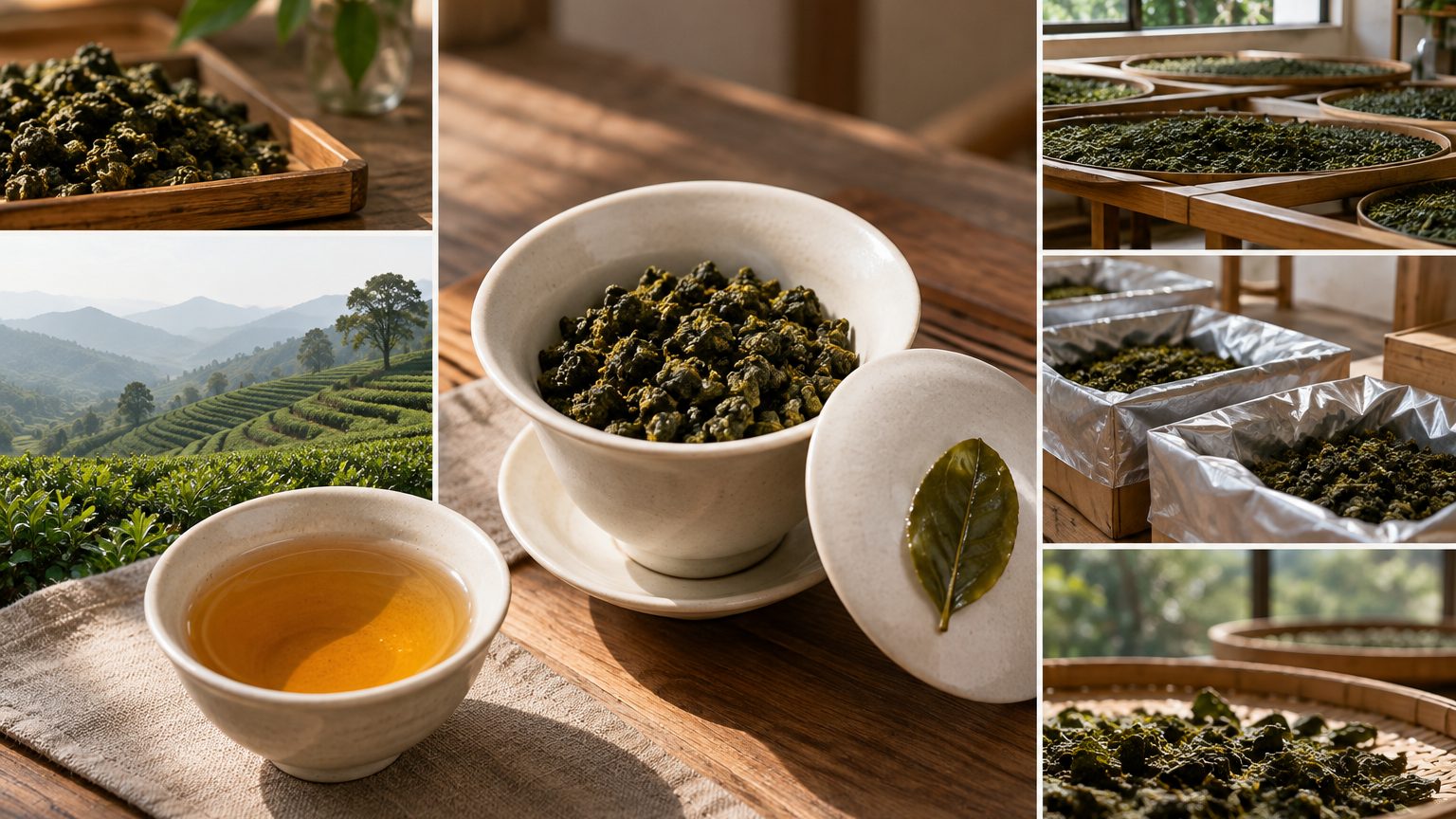
Tieguanyin divides into two families your customers will actually taste. The clean-aroma (qingxiang) style keeps the leaf's own florals: an orchid perfume, a green-gold liquor, a finish that lingers after the cup is empty. The roasted (nongxiang) style adds charcoal firing: deeper amber liquor, toast and dried-fruit notes, a rounder body that many hotel and restaurant programs prefer because it is forgiving in a thermos. Both come from the same rolled-ball process - withering, repeated shaking to bruise the leaf edges, fixing, rolling into granules, drying - and the desk stocks both, cupped side by side so the choice is a decision, not a surprise.
The cupping sheet, briefly
| Factor | Clean-aroma style | Roasted style |
|---|---|---|
| Dry leaf | Sandy-green tight granules | Darker granules, faint roast |
| Liquor | Green-gold, bright | Amber, bright |
| Aroma | Orchid, fresh cut green | Caramel, ripe fruit over orchid |
| Taste | Soft, sweet, lingering | Rounder, roasted depth |
| Wet leaf | Even green-red edge, whole leaves | Brown-red edges, pliable |
The term buyers hear most - guanyin yun - is not mysticism; it is the combination of fragrance that survives into the throat and a sweetness that returns after swallowing. It is also the first thing that degrades when stale stock is repackaged as premium, which is why every lot here is dated and cupped against the season reference.
How it is brewed, and why it matters to you
Tieguanyin is a gongfu tea: high leaf ratio, hot water, short infusions - about 7 g in a 110 ml gaiwan at 95-100°C, pouring off in under a minute and repeating six or more times. For menus this is a feature: a single 7 g charge serves a whole tasting flight, so food cost per service is easier to control than it looks from the MOQ sheet. For retail packs, the desk recommends the same parameters printed on-pack, and vacuum packing for the clean-aroma style, which is the more fragile of the two.
Sourcing notes for buyers
Anxi harvests spring and autumn; spring gives body, autumn gives the famous autumn aroma - many programs take both seasons. Grades run from estate-standard lots for foodservice up to competition-style lots for tea houses, and the honest trade-off is between intensity of yun and price stability across seasons. The desk's origin network covers Anxi directly, lots are cupped before shipping against the approved reference, and lab panels issue per batch. MOQ follows the desk's standard reference range for bulk oolong, confirmed in writing per program on the MOQ and lead time page.
Spring and autumn: choosing the season on purpose
Anxi harvests several times a year, but the trade cares about two windows. Spring lots bring body: thicker texture, deeper color, the cup that carries milk or holds up over a long meal service. Autumn lots bring the famous autumn aroma - a high, cool floral lift that retail customers often describe as fresher. Neither is better; they answer different briefs, and price moves against each season's outturn. The practical program is to cup both when they land and lock the one that matches your profile, then hold that reference as the bar for every later lot. Buyers who skip this step usually discover the drift when their customers do.
Grades, and what honesty looks like here
Tieguanyin grades are a spectrum, not a ladder with published prices: estate-standard lots for foodservice, mid lots for retail private label, and small-lot, single-garden material for tea houses. The honest variable is leaf provenance - within Anxi, certain villages command premiums the cup can usually justify, and outside Anxi, similar-looking rolled oolong from neighboring counties sells at a fraction. The desk's position is simple: the sheet states the origin plainly, lots are traceable, and if a budget forces a compromise, the buyer hears it before the order, not after the review. That is also why samples always precede bulk - see procurement process.
Packing for the shelf and the ship
Clean-aroma Tieguanyin is the tea most damaged by bad packing: its florals are volatile, so lots ship in foil-lined vacuum packs inside cartons, and retail formats move to alu-foil pouches with one-way degassing valves where needed. Roasted styles are sturdier and often rest in kraft-foil for a few months, which rounds the charcoal edge. For private label, the desk matches pack size to the brew ritual - 7 g single-serve tubes for gongfu markets, larger pouches for Western teapot habits - with artwork and compliance labels handled per destination market. The format decisions and their MOQ effects live on packaging options.
Where Tieguanyin fits in a range
Programs usually pair it one of two ways. As the oolong hero next to a black tea and a green tea, it covers the aromatic middle of a retail wall. As a roasted option - often next to Da Hong Pao - it anchors a hotel or restaurant list that needs forgiveness in service. If you are building either, the oolong category page compares all five oolong lines, and the quote form turns a profile into a sample plan.