
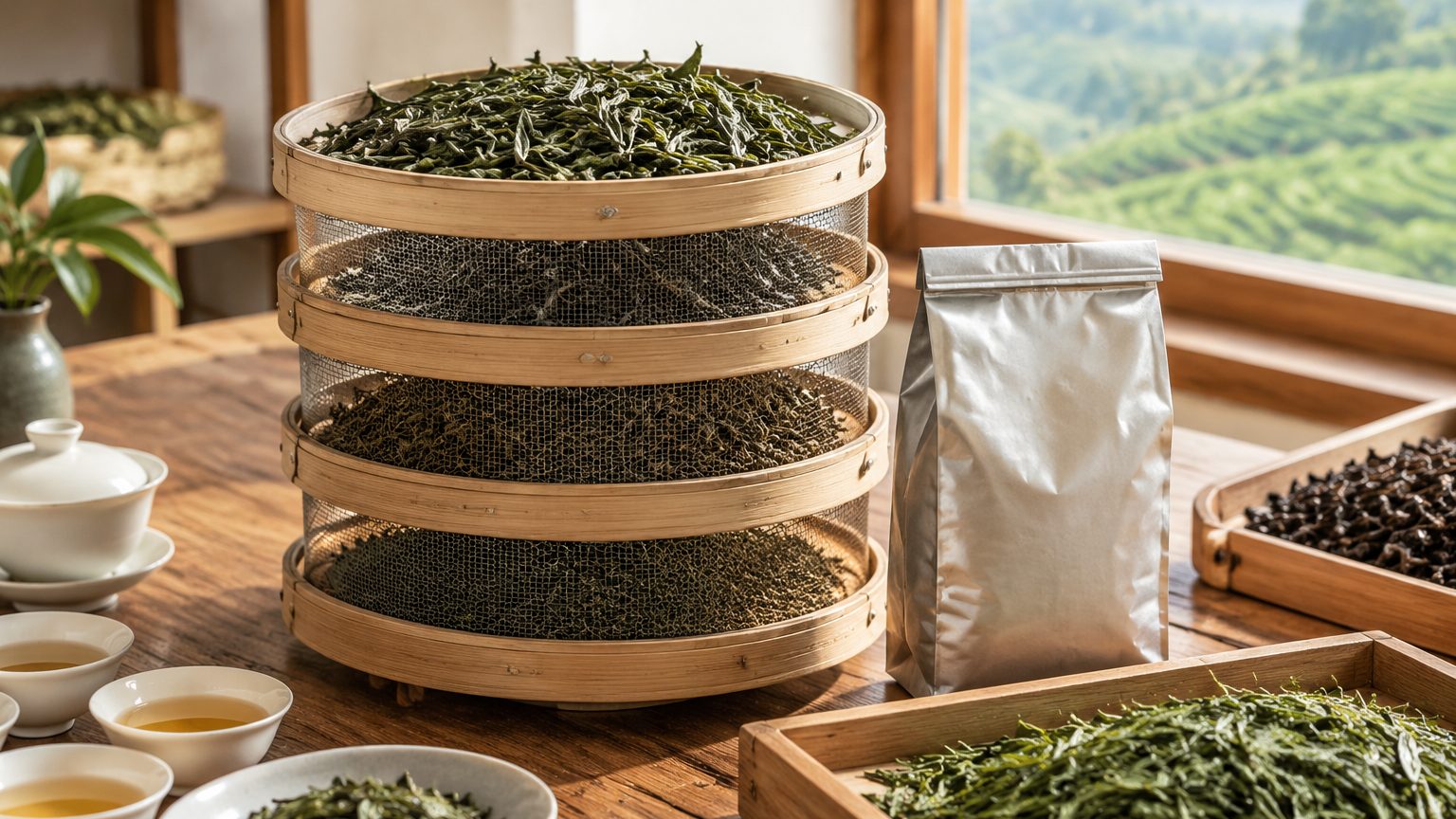
What grading means, and what it does not
Grading sorts finished tea by leaf size and appearance, mostly through sieving and winnowing after processing - a mechanical description, not a verdict on flavor. The systems differ by category. CTC black tea carries the familiar grade alphabet of particle sizes; orthodox and whole-leaf teas are judged more by leaf integrity, uniformity and the presence of buds or tips; Chinese specialty teas often carry grade names tied to plucking standards and craft rather than a published international ladder. Two lessons follow for buyers. First, a higher grade is not automatically the better cup for your use - a broken-leaf grade brews faster and stronger and may be exactly right for a bag program where a whole-leaf grade would underperform. Second, grade language is only comparable within a supplier's own system, which is why every grade claim here is backed by a sample and a cupping sheet. The sorting steps that create grades are described in sieving and grading, and the practical differences between leaf forms in loose leaf versus tea bags.
Lot records: the identity of a tea
A lot record is what makes a grade meaningful. It ties the physical tea to its origin, harvest window, process notes and packing date, and it is paired with a retained sample of exactly what shipped. With a lot record, 'the spring Longjing' is a specific, checkable identity: you can re-cup the retained sample against a later shipment and know whether the tea changed or the memory did. Without one, every reorder is a fresh gamble wearing the same name. The desk issues lot records per program as part of the standing quality control routine, alongside batch retention - and this is also the paper that makes substitutions auditable: a swap without written approval against the retained sample is a claim, not a delivery. When you compare suppliers, the presence and detail of lot records tells you more about how a company works than any certificate on the wall.
The four storage enemies
Finished tea is stable only if you make it so, and four things undo it. Light bleaches color and pushes grassy, aged notes forward - which is why clear-window packaging flatters a shelf and punishes the leaf. Oxygen dulls aromatics steadily; barrier foil and, for aroma-led packs, nitrogen flush or vacuum exist to keep it out. Moisture is the slow threat: tea is hygroscopic, and enough absorbed humidity flattens crispness long before any safety question. Odor is the fastest one - tea absorbs the smells around it, so warehouses that also hold spices, chemicals or strong-scented cargo will season the stock. The table summarizes the countermeasures; the warehouse-side detail is in tea warehouse conditions and the humidity mechanics in humidity control.
| Enemy | What it does | Standing control |
|---|---|---|
| Light | Fades color, accelerates stale notes | Opaque foil liners and cartons; no clear windows for long storage |
| Oxygen | Dulls aroma and top notes | Barrier foil; nitrogen flush or vacuum for aroma-led packs |
| Moisture | Softens crispness, then risks quality | Sealed liners, dry warehouse, desiccant discipline for retail packs |
| Odor | Absorbed into the leaf, fast | Segregated storage, odor-isolated transit stowage |
Shelf life, honestly, by category
Categories age at different speeds and pretending otherwise is how retailers end up with disappointed customers. Green tea is the sprinter: its brightness is seasonal by nature, and even well-stored stock drinks noticeably softer a year after harvest - programs live on the new season plus cold, dark, sealed storage of the previous one, as green tea shelf life explains. Jasmine rides the same clock, with aroma fading before the leaf does. White tea behaves differently: good stock changes slowly, and aging white tea is a deliberate practice with its own market. Roasted and fully oxidized teas are the steadiest - roast actually stabilizes oolong, and sturdy blacks hold well. Pu-erh is designed to change; time is an ingredient, within the limits of decent storage. Herbal and barley lines hold their character while their aromatics last, which depends on the ingredient's own nature.
Best-before dating for retail packs
A best-before date is a quality statement, not a safety calculation, and the defensible way to set one is to reason from three inputs: the category's honest aging behavior, the pack's barrier, and the storage conditions you can realistically expect in your channel. A nitrogen-flushed foil pouch of black tea supports a longer claim than a paper envelope of green tea, and both statements can be true on the same shelf. The desk states the packing date on the lot record precisely so your date can be reasoned rather than copied - a practice regulators and trade buyers increasingly ask you to justify. The mechanics and the defensible bases are laid out in best-before dating for tea; for freeze-adjacent folk wisdom, the freezer storage myth covers what condensation does to a bag that leaves the freezer.
Put storage into the spec, not the warehouse
Storage decisions belong at spec sheet stage, because format, barrier, nitrogen and even bag material are quality decisions wearing packaging clothes - the links run through packaging options and the program calendar through MOQ and lead time. Three habits carry most of the value. Order quantity against real velocity, so green tea is not still selling twelve months after its season. Book shipments that minimize port dwell for the fragile categories in summer. And store with the four enemies in mind - dark, sealed, dry, away from odors - from the packing floor to your customer's cupboard. If a category's aging behavior matters to your program, say so in the brief and the desk will plan the lot rotation accordingly; pu-erh aging projects have their own note in storing pu-erh cakes, and white tea's slow arc in the white tea aging guide.