
Eleven steps, one paper trail
The spine below is deliberately unglamorous. Every step produces a document, and every later step refers back to an earlier one, which is what keeps a program auditable when people change jobs, harvests move or a container is delayed. Custom programs use all eleven; a stock reorder can run through them in an afternoon.
- Brief. You state the market, channel, cup profile, format and intended quantity. Vagueness here is fine - the desk's job is to turn a rough brief into a workable spec, and the first reply comes in writing, usually within two working days.
- Spec sheet. The desk drafts a one-page specification: line, grade, origin, harvest window, brew parameters, packing format, certificates needed. You approve it or correct it; nothing is bought against an unapproved spec.
- Shortlist. Candidate lots and partner facilities are matched to the spec from the origin network, with an honest note on each - what is abundant this season, what is scarce, what the calendar allows.
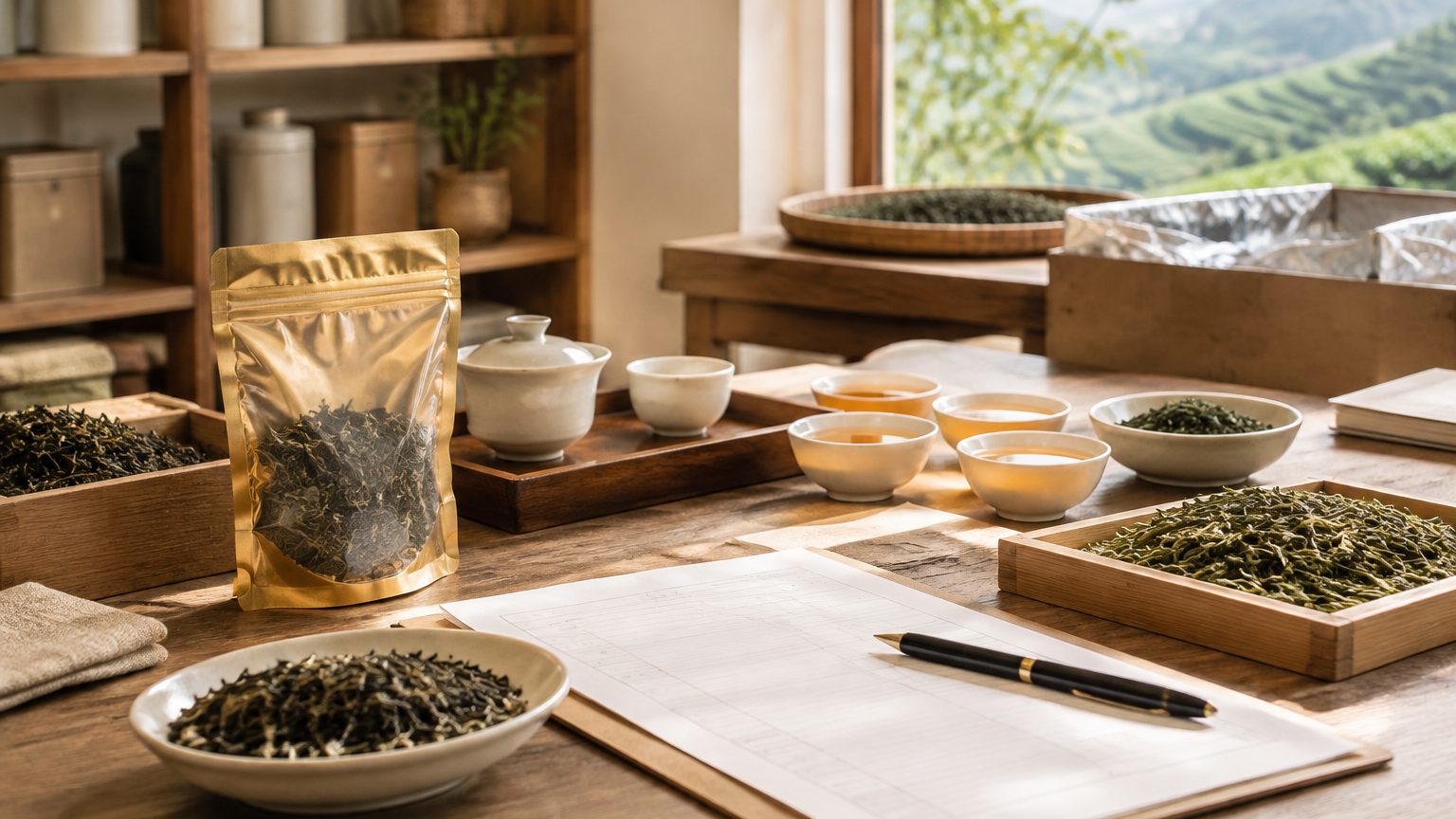
- Samples. In-stock teas ship in 3-7 working days; custom blends are built and cupped first, adding 7-15. Samples travel by courier with a sample sheet that matches the spec.
- Cupping and adjustment. You cup against your reference - five factors: dry leaf, liquor, aroma, taste, wet leaf - and the desk adjusts. Blends go through as many rounds as the profile needs; this is where the program is actually designed.
- Golden sample. The approved sample is sealed in portions and both sides keep them. It becomes the physical contract: bulk is made to match it, and disputes are settled by cupping the golden sample, not by memory.
- Purchase order. The PO locks quantities, the binding MOQ, price, lead time, shipping terms and documents. The written offer behind it sets validity against the current market.
- Production. Packing and processing run against the spec sheet, with batch retention per lot. Private label work adds artwork proofing before the run; new blends add a production sample for approval.
- Inspection. Before packing completes, goods are checked against spec and golden sample - appearance, moisture behavior, packing integrity - and the third-party lab panel issues per batch in your name.
- Shipping. Cartons are palletized and booked per the freight plan; the document stack - invoice, packing list, transport document, origin certificate, per-program papers - is shared as PDFs before originals travel.
- After-sales. Arrival is checked against the inspection report; any claim runs against the golden sample and the batch records. Reorder planning starts while the container is still at sea, because the next order inherits everything this one proved.
Each stage has its own checklist - what to verify, what to put in writing, which documents to expect back - and the desk runs them in the same order every time. The quality gates inside this sequence are described under quality control, the paperwork stack under certifications, and freight planning on logistics.
Where programs usually stall
The stalls are predictable enough to list. Artwork that arrives after production is scheduled is the classic one - it converts a 20-35 day private label run into a calendar argument. Certificate requests discovered late in the process are the second: if your channel needs organic chain documents or a specific lab scope, that belongs in the brief, not in week five. The third is spec drift - a buyer cupps a sample in March, remembers it in July as slightly better than it was, and asks for 'the same but a bit stronger'. The golden sample exists precisely to make that conversation concrete: the desk re-cups the seal against the new request and quotes the change as a change order, or explains what the request would cost in grade. None of these stalls is fatal; all of them are cheaper at step two than at step nine.
What exists in writing at each step
Buyers who audit suppliers often ask what documentation a program leaves behind. The answer is a folder per program, one document per step, summarized below. Batch retention means that months later, a lot can be re-cupped against what actually shipped - the basis for the quality control routine and for any claim. If your own compliance team needs the folder in a specific format, say so at the brief; it is easier to build the folder right than to rebuild it.
| Program stage | Document produced | What it settles |
|---|---|---|
| Brief to shortlist | Brief as received; approved spec sheet | What the program is for, and what will be sampled |
| Sampling rounds | Sample sheet and cupping notes per round | How each candidate cupped, and what was adjusted |
| Golden sample | Seal record; sealed portions both sides | The physical reference bulk is made against |
| Offer and PO | Written offer; purchase order | Binding MOQ, lead time, terms, documents |
| Production | Batch records with retained samples; artwork approvals | Traceability per lot; what was packed and when |
| Inspection | Pre-packing report; third-party lab panel per batch | Conformity to spec; safety panel in your name |
| Shipping and after | Invoice, packing list, transport paper, origin certificate | Clearance on import; arrival checks against the report |
Changing a spec mid-program
Change happens - a market test moves a launch date, a regulation changes a label, a harvest runs late. Mid-program changes are handled as written change orders that state what changes, what it does to cost, lead time and the golden sample, and who approves. Small changes - a carton weight, a label typo fix - ride alongside the run. Structural changes - a different grade, a new blend ratio, a different pack format - re-open the relevant steps: re-sampling for a blend change, new tooling lead time for a mold change. What is never done is an undocumented substitution: if a lot runs short, the replacement requires your written approval against the golden sample, and a swap without one is a claim, not a delivery. The mechanics of keeping a blend steady across harvests are covered in keeping a blend consistent.
After the container lands
The program does not end at the port of discharge. Goods are checked on arrival against the inspection report - count, condition, and a sensory spot check against the golden sample by whoever on your side owns the cup. Claims windows are stated on the PO and are generous when the paper trail is complete, which is the practical reason the spine exists. Then the useful part: reorder planning. A first program tells you what your customers actually reordered, at what speed, which grades carried the repeat and which formats sat. The second order runs through the same spine in a fraction of the time because every document already exists. For a reorder cadence or a second program, start again at the brief - it takes one paragraph the second time.