
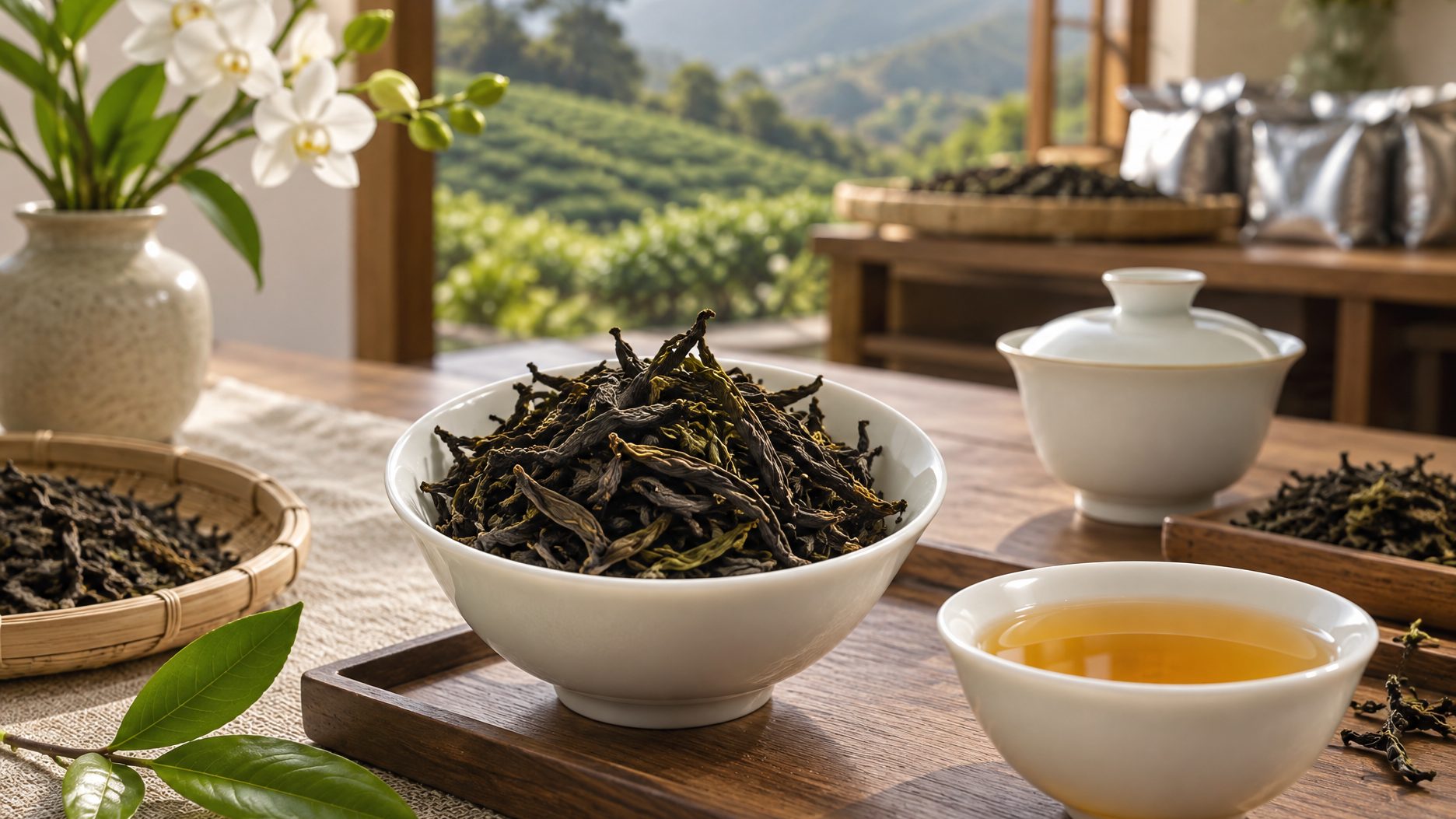
The quiet anchor of the rock tea range
Among Wuyi cultivars, Shui Xian plays the low voice. Its signature is the orchid base - a soft floral undertone that never jumps out of the cup - laid over a thick, mellow body that carries roast and mineral without the angular spice of Rougui or the fruit drama of top Da Hong Pao. The cultivar is older and more widely planted than its famous siblings, grown both in the core rock valleys and across north Fujian (Minbei), where it also ships as a standalone Minbei oolong in lighter styles. That breadth is a procurement asset: Shui Xian covers the widest quality-to-price span of any rock line, from honest everyday lots to core-rock material, and the desk programs all three tiers.
Terroir and the two homes of Shui Xian
Inside Wuyi's valleys, Shui Xian gets the same cliff-side treatment as its siblings and emerges as full rock tea with mineral structure under the orchid. Across north Fujian - the broader Minbei belt - the same cultivar grows in more conventional gardens and often receives a lighter roast, giving a rounder, softer tea that suits pot service and mixed retail shelves at friendlier prices. The desk keeps the distinction explicit on lot sheets: Wuyi core, Wuyi outer, or Minbei, each with its reference sample. Buyers choosing between them are choosing channel fit, not quality in the abstract - tea houses want the core cup, foodservice and hotel lists often prefer the Minbei roundness because it forgives thermoses and long holds. Both are legitimate; both should be sold as what they are.
Processing and roast
The chain matches other rock teas: withering, overnight bruising for partial oxidation, fixing, rolling into strips, charcoal roasting in passes with rests. Shui Xian traditionally takes a medium roast - enough fire to settle the leaf into stability and round the florals into sweetness, not so much that the orchid disappears. Leaf character matters here too: the cultivar's broad leaves build body, which is why Shui Xian lots feel thicker in the mouth than same-roast material from thinner-leaf cultivars, and why the tea holds up through more infusions than its price tier suggests. For buyers tracking process detail across categories, the processing guide places rock tea in the full six-type framework.
The cupping sheet
| Factor | What the reference shows |
|---|---|
| Dry leaf | Broad, dark, twisted strips; even roast bloom |
| Liquor | Orange-red, clear, with weight |
| Aroma | Orchid undertone, toast and wood behind |
| Taste | Mellow, thick, mineral-soft; gentle sweet finish |
| Wet leaf | Large, soft, red-brown leaves; even oxidation |
Brew parameters and service behavior
Standard gongfu applies: 7 g in a 110 ml gaiwan at 95-100°C, quick pours, six or more infusions from one charge. Shui Xian is the rock tea most tolerant of imperfect service - a missed pour or a longer steep bends it toward roast sweetness rather than bitterness, which is why hotel and banquet programs favor it where staff turnover makes precision unrealistic. For retail, the mellow profile suits tea drinkers moving from black tea toward oolong; the pack can promise a forgiving cup truthfully. The desk prints the reference parameters on lot sheets and, under the private label program, aligns on-pack brewing copy with the spec so service and label agree.
Grades, pricing tiers and stock behavior
Three tiers cover the line. Core-rock Shui Xian carries the mineral-plus-orchid cup and core pricing, for tea houses and connoisseur retail. Standard Wuyi material delivers a clean, well-roasted cup at working prices - the volume tier for retail private label. Minbei-style lots trade some structure for softness and price, fitting foodservice, hospitality lists and entry retail. As everywhere at the desk, the lot sheet names the tier, the golden sample defines it, and the written offer binds the two together. Because the dry leaf across tiers looks similar, buyers should resist grading by eye and grade by cup - the sample checklist exists for exactly this. Reference MOQ ranges sit on the MOQ and lead time page and are confirmed in writing per program.
Spring harvest, autumn-roasted release: rock tea's calendar again. Shui Xian's thick leaf and medium roast give it long shelf stability - a year or more as a typical reference when sealed and cool - and lots often drink smoother after months of rest, which lets buyers order ahead without the freshness anxiety of green tea. That stability also makes it a sensible first Wuyi line for a program testing the category: lower risk in freight, in storage and in service, while still teaching customers what rock tea means. Corporate gifting takes it in gift boxes; the gifting program pairs it with a lighter tea so the set shows range.
What to check before bulk
- Origin tier on the lot sheet: Wuyi core, Wuyi outer or Minbei.
- Roast level and roast date; rest since firing.
- Orchid base present under the roast - not buried by char.
- Cup at 7 g / 110 ml: thickness and mellowness against the reference.
- Wet leaf: broad intact leaves, even oxidation, no scorch pockets.
- Lab panel per batch and documents per destination market.
For a full Wuyi comparison in one sitting, sample Shui Xian beside Rougui and Da Hong Pao, or start from the oolong hub; profiles go to the desk for a written sample plan.