
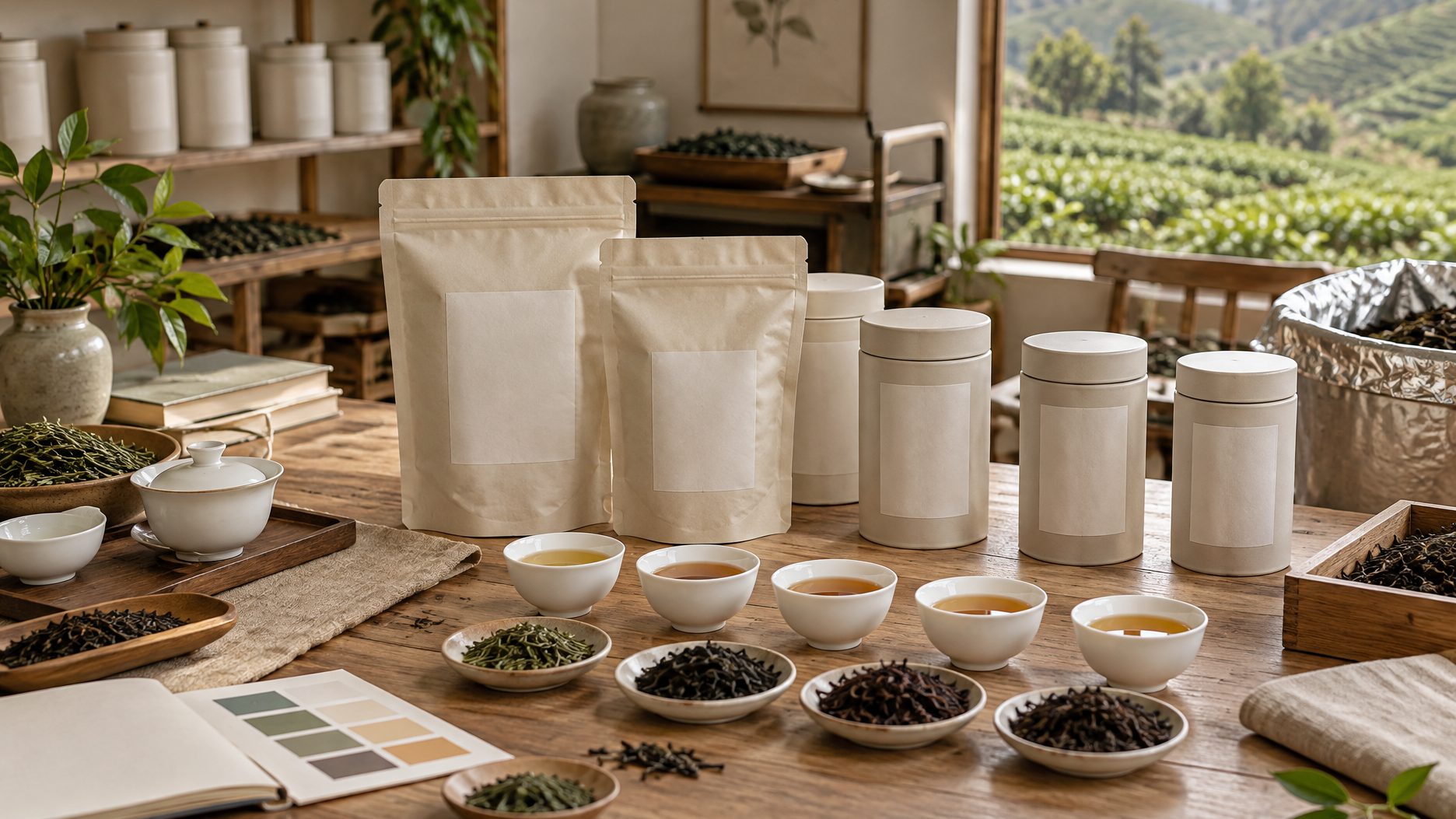
What private label means on this site
Private label is not a stock pouch with your logo dropped in a template. It is the point where three workstreams meet: the tea itself, already selected and locked to a golden sample; the pack, specified in packaging options and then branded; and the label, built to the rules of the country where the product will be sold. The desk coordinates all three against one timeline, because in practice they move at different speeds - tea is cupped in weeks, printed packaging has its own production run, and label review is the step new brands underestimate most. What follows is how the program runs and where the realistic minimums sit.
Where your logo goes
Branding surfaces follow the format. The desk's advice at brief stage is usually to spend the brand budget where the customer lingers - the front panel and the box - and keep the rest clean; a crowded pouch costs more to print and reads worse on a shelf. Every surface decision lands in the pack spec sheet before artwork starts, so the design is drawn to a real dieline, not guessed at one.
| Surface | What carries the brand | Note |
|---|---|---|
| Alu pouch, retail | Front panel logo, story panel behind | The workhorse for e-commerce and specialty retail |
| Tin | Direct body printing or a wrap label | Tooling order applies; premium shelf presence |
| Gift box | Printed rigid wrap, foil stamping or belly band | Gifting programs lead with this surface |
| Pyramid bag program | Outer sachet and carton; tag carries name and brew line | Bag film itself stays unprinted |
| Bulk carton | Plain shipping mark | No brand artwork - nobody sees it twice |
The artwork process, step by step
- Brief: brand assets, format, market, the claims you intend to make.
- Dieline and pack spec locked for each SKU.
- Design draft on the dieline, reviewed by you and by the desk for print feasibility.
- Label compliance read for the destination market, revisions applied.
- Digital proof signed off; printed sample produced on the actual film or tin.
- Golden pack sample sealed - the reference bulk packs are judged against.
- Volume run against the golden pack sample, with inspection before shipping.
Two checkpoints matter more than the rest. The printed sample, in the real material, is where color and finish surprises surface - foil, matte and unbleached films all shift how a logo reads. And the golden pack sample is what makes reorder number two as safe as order number one: the desk cups the tea against the tea reference and checks the carton against the pack reference, so a quiet substitution of either becomes visible immediately.
Label compliance per destination
A tea label is a legal document with a design on it. Markets differ in what must appear - ingredient declaration, net weight, country of origin, nutrition panel, importer or responsible-party details, and language - and they differ in how flavored or scented teas must be named and what claims a food label may carry. The desk prepares label content per destination market as part of the program: the compliance reading happens before the proof is signed, so corrections cost days rather than print runs. Health-adjacent claims are kept inside what food labeling rules allow in your market; rules on claims vary by destination, and the safe version of a good story is checked, not improvised. The basics live in tea food labeling basics, and the certification claims that may appear on a label are governed by the document chain under certifications.
MOQ: the realistic band
The standing reference band for conventional private label runs about 100-300 kg per item or 5,000-20,000 bags per item, depending on format - with the binding figure confirmed in writing per program, since the tea grade, the pack size and the print run all move the number. Pyramid bag filling is a line-scheduling question and starts at the hundred-thousand-bag scale; gift boxes reference 500-1,000 boxes; tins carry their own tooling order above the pouch band. New buyers sometimes arrive expecting single-figure minimums on printed packaging, and the honest answer is that print is the constraint: a custom-printed pouch or tin exists as a manufactured object with a run size, which is why the desk often proposes starting a hero SKU in printed packs and supporting SKUs in sticker-label pouches until volume justifies the print run. The full ladder and the calendar effects are set out under MOQ and lead time.
Golden sample for the pack, not just the leaf
Programs live or die on repeatability, and the pack has its own repeatability problems: print color drifting between runs, a film change that alters the seal, a box weight that reads cheaper on arrival. So the program locks two golden references - the tea and the pack - and every shipment is checked against both before it leaves the packing floor: cup against the tea reference, pack against the pack reference, documents in the file. When a component must change - a discontinued film, a new tin supplier - the change is proposed in writing with a revised sample for approval, never shipped silently. That is the whole trick behind private label that still looks right on reorder five.
Who this suits, and the first step
Private label suits e-commerce tea sellers building a brand wall, retailers wanting a house range, cafes and hotels extending the brand past the counter, and corporate gifting programs that need a name on the box. The desk has run each pattern, and the differences are mostly in which SKU leads - a gifting program leads with the box, an e-commerce brand with its hero pouch. The working sequence is short: send the brand idea, market and intended quantities through the quote form; receive a written plan with format options, MOQ references and a sample timeline; cup the tea; approve the proof and the golden pack sample; run. If you want the commercial side first, the reference ranges and lead times are on MOQ and lead time, and the range-building logic for a first line-up is sketched in private label MOQs explained.