
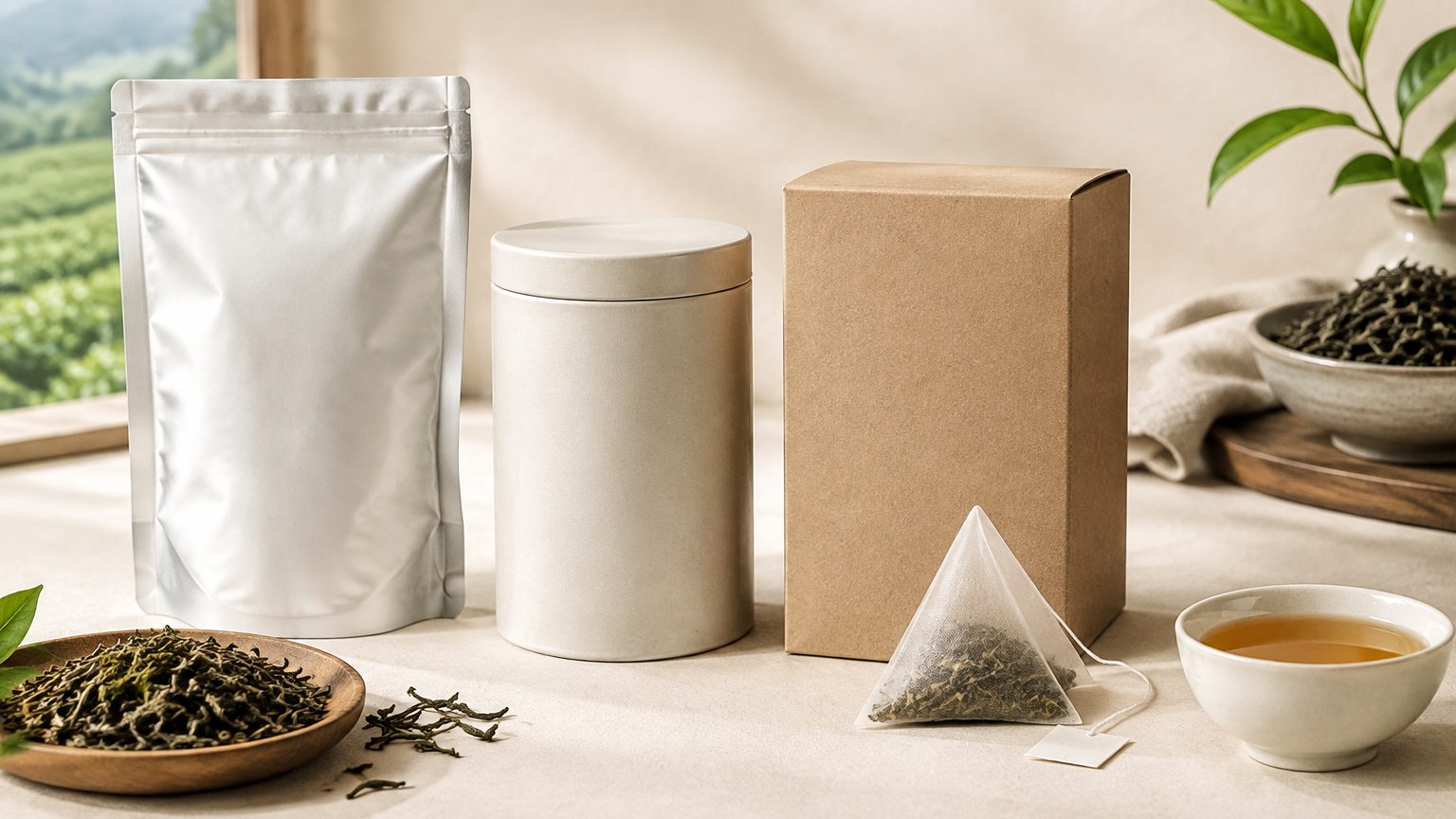
Six formats, one decision tree
Tea leaves the packing facility in one of six basic shapes, and everything downstream - shelf life, cost per unit, label claims, even which grade makes sense - follows from that choice. Bulk cartons serve buyers who pack or blend further. Alu pouches and tins are the retail workhorses. Gift boxes wrap the product for an occasion. Pyramid bags and flat bags turn the tea into a brew-ready unit, at the price of moving filling into the supply chain. The table below is the short version; the sections after it explain the logic so you can defend the choice internally.
| Format | Best for | Protection approach | MOQ effect, typical reference |
|---|---|---|---|
| Bulk foil-lined carton | Foodservice, blending, repackers | Alu foil liner inside a corrugate carton | Lowest band: from 50-100 kg per line |
| Alu pouch, retail size | Specialty retail, e-commerce | Multi-layer foil, optional valve, optional nitrogen | From about 100-300 kg or 5,000-20,000 bags |
| Tin | Premium retail, gifting | Rigid, fully light-proof body | Set by the tin tooling order, above the pouch band |
| Gift box | Corporate and seasonal gifting | Box plus inner pouches, tins or sets | Typically 500-1,000 boxes |
| Pyramid bag, filled | Hotels, cafes, DTC | Sealed sachet or overwrap per bag | Filling at 100,000-bag scale |
| Flat bag, filled | Volume retail, foodservice | Envelope or single-wrap | Filling at the same bag-filling scale |
What the pack must stop: oxygen, light, moisture, odor
Finished tea degrades along four axes, and each format is judged by how it handles them. Oxygen dulls aromatics and slowly flattens the cup, which is why the base of almost every format is a foil layer or liner rather than plain paper. Light bleaches chlorophyll and pushes grassy, aged notes into green teas, so clear windows look friendly on a shelf and work against the leaf. Moisture is the quiet one: tea is hygroscopic, and enough absorbed humidity dulls crispness first and risks spoilage last. Odor is the most under-rated - tea absorbs the smells around it, so a liner that survives a warehouse of spices or a hot container is not a detail. The desk's default is a foil liner inside a carton even for bulk, because the carton edge is where liners tear and the smell test starts.
Nitrogen flush: when it earns its place
Flushing a pouch with inert gas before sealing displaces the oxygen inside, and for some teas the difference survives to the cup. It earns its cost on aroma-led packs: clean-aroma Tieguanyin, jasmine lots close to their scenting rounds, high-grade greens sold months after harvest. It is usually unnecessary for roasted oolongs, pu-erh and sturdy black teas, where the pack's ordinary barrier does the job. Vacuum sealing is the other tool, common for rolled oolongs; it suits dense granules better than flat leaves, which can crush. The decision is made at spec sheet stage, not at packing, because it changes the film spec and sometimes the filling line. The mechanics and trade-offs are written up in nitrogen flushing for retail tea packs, and the oxygen-barrier reasoning behind film choice in the oxygen barrier note.
Label compliance per destination
A label is a legal document that happens to sit on a pretty surface. Requirements differ by destination market - ingredient declaration, net weight, country of origin, nutrition panel, language, and how a flavored or scented tea must be named - and the desk prepares label content per destination market as part of the private label program. Two practical notes save buyers the most pain. First, format changes claims: a pyramid bag program has bag material to declare, and degradable-material claims follow the material report, not marketing preference - the PLA versus nylon comparison covers what the reports actually say. Second, translations are checked against your market's regulatory vocabulary, because a word-for-word translation of a tea name can create a claim where none was intended. The basics are summarized in tea food labeling basics.
How MOQ moves with format
Each step from bulk toward retail adds tooling, handling and setup, and the MOQ ladder reflects that. Bulk loose leaf carries the lowest band - the 50-100 kg per line reference - because it needs a liner and a carton and little else. Retail pouches move to the private label band, roughly 100-300 kg or 5,000-20,000 bags per item, once your artwork is printed. Pyramid bag filling is a line-scheduling question and starts at the hundred-thousand-bag scale; empty bags for your own filling line follow the same logic. Tins and gift boxes carry their own tooling orders, with boxes typically referenced at 500-1,000. None of these numbers is a quote - the binding figure is the one in your written offer, as explained under MOQ and lead time. New molds or new packaging structures also extend lead time into the 35-60 day range, which matters if a launch date is fixed.
Choosing by channel, not by preference
The format that looks best is not always the one that sells best in your channel. Foodservice buyers overwhelmingly choose pyramid bags for consistency and speed of service, with a bulk carton behind the bar for pot service. Specialty retail lives on resealable alu pouches at 50-100 g, where the customer reads the story. E-commerce favors the same pouches plus gift-ready outer boxes, because shipping is the rough edge. Corporate gifting is box-first: the occasion justifies the packaging, and the tea inside is chosen to match. If you are torn between two formats, the desk will often suggest running the hero SKU in the premium format and the supporting SKUs in the simpler one - a split that keeps the shelf impact where it pays. Send the channel and the brief through the quote form and the desk returns format options with sample implications in writing.