
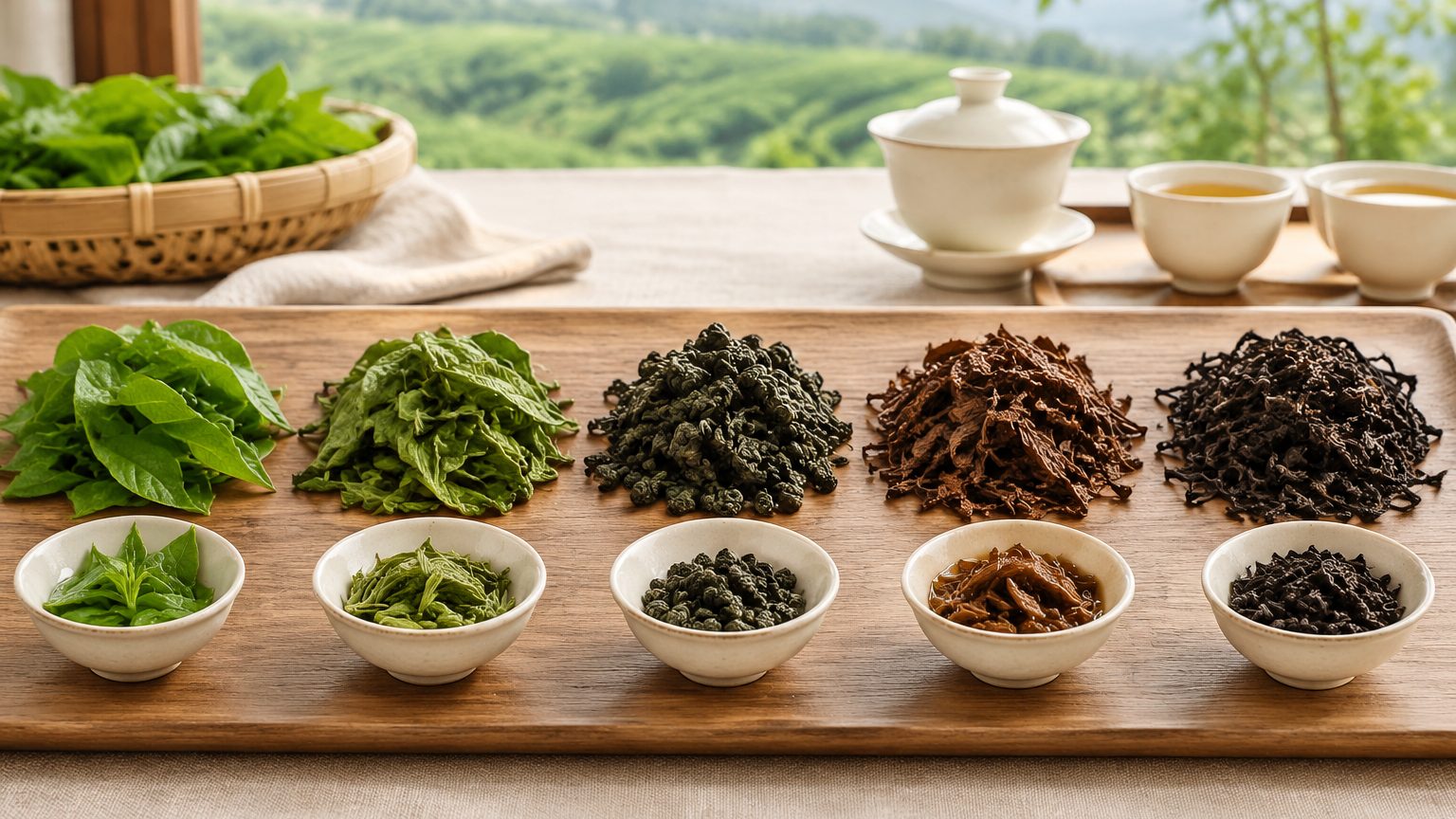
Processing, not color, defines the type
The trade classifies tea by processing, not by the color of the leaf or the liquor, and the single variable that matters most is oxidation - the enzymatic browning that begins the moment a leaf is picked. Stop it early and the tea stays green. Let it run fully and the tea turns black. Hold it in the middle, deliberately, and you have oolong. Skip the fixing step altogether and handle the leaf as little as possible for white tea. Take already-finished tea down a second, microbial path and you have pu-erh. Herbal and barley 'teas' sit outside the system because they are not from the tea plant at all - the six types overview covers the classification in one page if you want the short version first.
| Type | Oxidation | Defining steps | Category page |
|---|---|---|---|
| Green | Stopped almost at once | Fix by pan or steam, roll, dry | green tea |
| White | Slight, uncontrolled | Wither long, dry - no fixing, no rolling | white tea |
| Oolong | Partial, deliberate | Wither, bruise edges, fix, roll, often roast | oolong tea |
| Black | Full | Wither, roll, oxidize fully, dry | black tea |
| Pu-erh | Then post-fermentation | Sun-dry maocha, press, age or wet-pile | pu-erh tea |
| Herbal, barley | Not applicable | Dried flowers, leaves, grains - no tea plant | herbal tea |
Withering: where flavor starts
Fresh leaf is grassy, brittle and wet; almost every tea begins by softening it on trays or in troughs until it loses water and the chemistry inside begins to move. Withering length is a flavor decision: short withers keep green teas bright and snappy, long soft withers set up the fruit and honey notes that black tea oxidation will build on, and white tea's slow, whole-leaf wither is essentially the entire process - its sweetness comes from that one patient step. For buyers, withering explains why two lots of the same cultivar can cup differently between seasons and makers: the step is hours long and judged by hand, which is why the desk cups lots rather than assuming from names. The mechanism, and why it is sometimes called 'the color switch', is written up in withering and oxidation.
Fixing: the green tea fork
Fixing - kill-green - is the heat step that denatures the oxidation enzymes, and how it is done splits the green tea world. Pan-firing gives the Chinese greens their toasted, chestnut character: the flat-pressed Longjing is the reference, as on the Longjing line. Steaming gives Japanese greens their vegetal, marine lift - sencha is the everyday example, and the difference between steamed and pan-fired is the fastest way to explain 'why does Japanese green tea taste green' to a customer. After fixing, rolling and shaping give each style its form and set the leaf's cell structure for brewing. One branch of this family deserves its own mention: jasmine tea is a green base scented afterward with fresh flowers across repeated rounds, which is processing by fragrance rather than by heat - the rounds are counted in jasmine scenting rounds and the line itself is on the jasmine page.
Rolling, shaping and the bag decision
Shaping is not cosmetic. Twisting strips of black tea breaks cells and sets up a fast, strong brew; ball-rolling oolong into tight granules protects aroma and lets a leaf unfurl over six or more infusions; pressing pu-erh into cakes buys it a life of decades. And shaping decides bag suitability before any conversation about bags starts: CTC - crush, tear, curl - exists precisely to machine-roll leaf into hard granules that brew fast and strong in a bag or a milk tea, which is why the CTC line is the beverage-program default. Whole-leaf orthodox shapes, by contrast, reward space and water volume and disappoint in a flat bag. When a buyer asks 'can this tea go in a pyramid bag', the honest answer depends more on how the leaf was shaped than on its category.
Roasting: the second flavor
Roasting is a second, optional flavor pass over finished or near-finished tea, and it changes category rather than decorating it. Rock oolongs from the Wuyi mountains are defined by charcoal firing: repeated passes over embers that push fruit, toast and mineral depth into the leaf and stabilize it for storage - the Da Hong Pao and rougui lines are the reference points. Tieguanyin exists in both worlds, clean-aroma without the fire and roasted with it, which makes the pair a tidy demonstration for a menu. Roasting also serves green and oolong programs as a finishing touch that rounds edges and dries residual moisture before packing. What charcoal actually changes, pass by pass, is covered in charcoal roasting notes; for buying purposes, treat roast level as a spec line, cupped and locked like any other.
Post-fermentation: the pu-erh path
Pu-erh starts where other teas end: sun-dried maocha is compressed into cakes and handed to time. Raw pu-erh ages slowly by ambient microbes and years - the cake you buy this year will cup differently in five. Ripe pu-erh compresses decades into weeks: a wet-piling step ferments the maocha deliberately under controlled moisture and heat, producing the dark, smooth, earthy cup that sells as ripe cake. The two are different teas built from the same starting material, and the fork is explained line by line in raw versus ripe pu-erh; the wet-piling step itself is walked through in pu-erh fermentation explained. Chenpi pu-erh adds a second processed ingredient - aged tangerine peel from Xinhui - blended or packed whole, proof that the category's processing logic extends to what is paired with the leaf.
What the matrix means when you buy
Processing knowledge pays off in three practical habits. First, ask for process notes on the lot record - wither length, fix method, roast passes, pile dates for pu-erh - because they predict the cup better than origin names alone. Second, match the process to the use: strong, fully oxidized, machine-shaped material for milk drinks; delicate, unfixed material for sipping programs; aged or roasted material where stability across a long menu life matters. Third, treat scenting and blending as processing too - a jasmine's rounds and a blend's ratio are as much a spec as a roast level. If you want to feel the matrix rather than read it, ask the desk for a cross-category sample set and cup the six types side by side; one afternoon with a comparison tray teaches more than any page, including this one.