
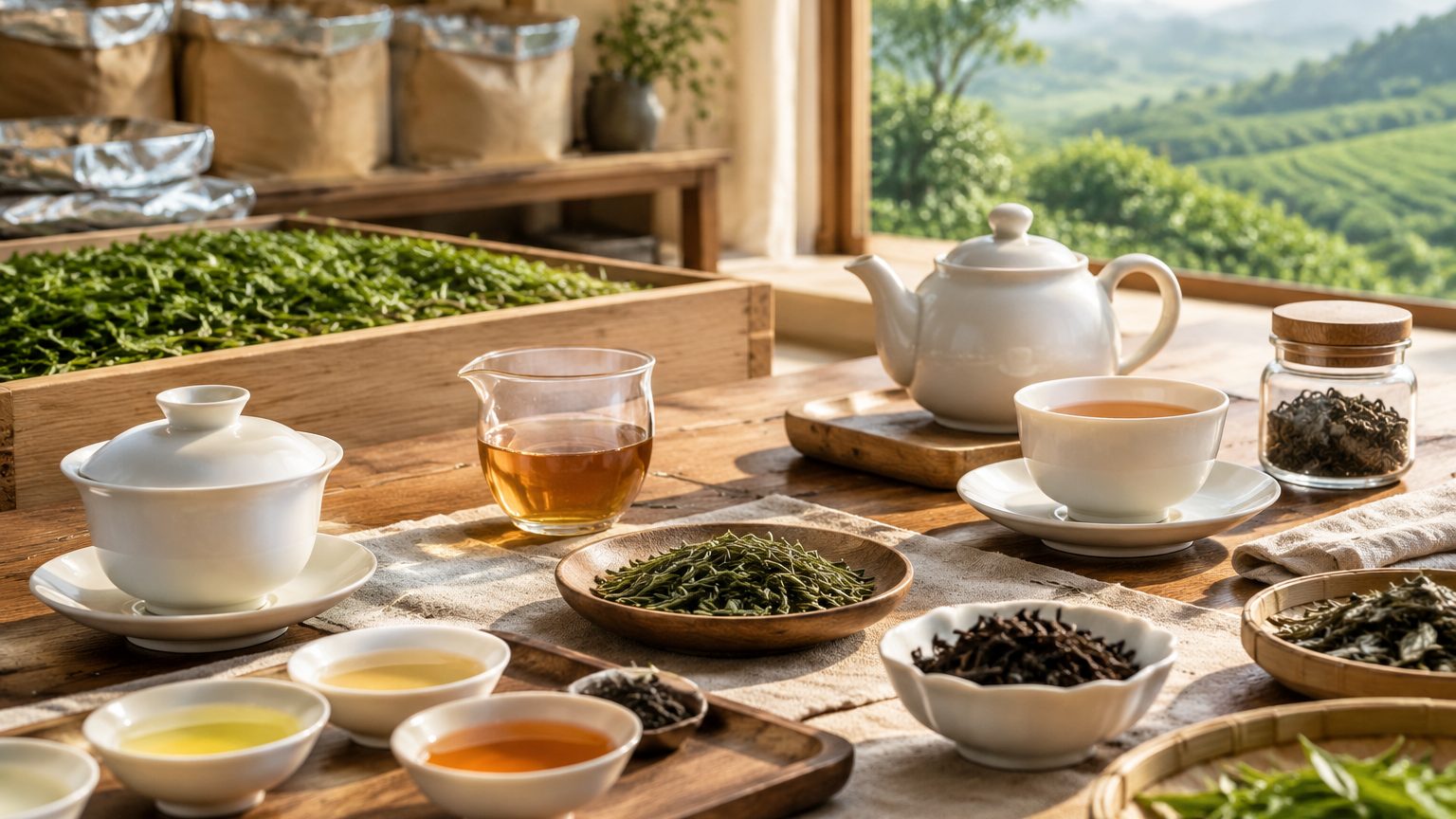
The cup that has to survive service
Hospitality tea is bought per cup, and the per-cup math is unforgiving in both directions. Over-portion and the margin dies quietly across thousands of covers; under-portion and guests notice a thin cup before they notice anything else about the venue. The desk treats this as a specification problem, not a guessing game: brew ratios are fixed per program - a workhorse black at 2-3 g per 200 ml, a roasted oolong pot at 7 g per 110 ml for multiple pours - and the arithmetic of strength against portion is laid out in brewing strength and cup cost. Once the portion is fixed, the golden sample locks the leaf that delivers it, and the brew card tells the kitchen exactly how.
Bag or leaf: run both from one spec
Most venues need both formats and do not want two suppliers. Pyramid bags carry the speed business: room service, takeaway, the barista who has forty seconds between orders. Loose leaf carries the pots that justify the venue: afternoon service, tea pairings, the gongfu list. The desk supplies both from the same lots where the cut allows - broken-leaf grades fill bags, whole leaf goes to the tins - so the cup stays recognizably the same across formats. Pyramid filling runs at around a 100,000-bag scale per fill run as a reference, with empty bags plus tags available for groups that fill their own; the format decisions sit on pyramid tea bags and packaging options.
Four lines that cover most menus
| Line | Menu role | Service behavior |
|---|---|---|
| English-style CTC | The pot of black tea guests expect; takes milk and lemon | Strong, red, extracts clean at scale without bitterness spikes |
| Lemon black tea | Iced program anchor that pours hot in winter | Citrus-forward, holds flavor over ice; one SKU, two seasons |
| Barley tea | Caffeine-free by nature; buffet and banquet urn filler | Roasted-grain profile that never over-steeps bitter; hot or cold |
| Roasted Tieguanyin | The forgiving oolong that reads premium on a list | Amber, toasty, stable in an airpot; survives guest error |
That quartet is a starting roster, not a ceiling: herbal blends cover the caffeine-free table beyond barley, and a jasmine or keemun slots in where aroma sells the pot. The desk will also say plainly when a requested line fights the format - delicate silver needle is a poor pyramid-bag citizen and worse in a holding pot, whatever the menu font suggests.
Why the roasted oolong earns its slot
Clean-aroma oolongs are lovely and fragile: their florals fade fast in a hot holding vessel and turn hollow within the hour. Roasted Tieguanyin has the opposite temperament. Charcoal firing rounds the leaf, the amber cup stays stable through a long service, and a guest who forgets the timer gets strength rather than astringency. It is the line the desk recommends when a venue wants oolong on the menu but cannot staff gongfu brewing at every table - and the gongfu parameters still exist for venues that do want the ritual: 7 g in a 110 ml vessel, quick pours, six or more infusions from one charge, as the brewing guide details. One SKU, two service styles, one golden sample behind both.
Specs, packs and documents for food service
Food service runs on paperwork that matches its audits. Each program ships with brew cards - ratio, temperature, time - that the kitchen can tape inside a cupboard; lot records carry packing dates; ingredient and allergen declarations accompany scented or flavored lines such as the lemon black. Bag materials are food-grade PET nylon or PLA with material statements available; third-party lab panels issue per batch in the buyer's name; partner packing facilities commonly hold ISO 22000 or HACCP systems, verified per program. US-bound programs fall under FDA food facility registration, and EU programs plan MRL work under Regulation (EC) No 396/2005 as amended. The document stack is summarized on certifications.
From tasting to standing order
The path is the desk's standard spine: brief, samples (typically 3-7 working days for in-stock teas), cupping at your counter, golden sample sealed, then bulk with inspection before packing. Bulk lead times run 10-15 working days for in-stock lines and 20-35 days for packed programs, as reference ranges confirmed in writing per order - the mechanics are on MOQ and lead time. An illustrative case, generic on purpose: a cafe group with a dozen outlets standardizes on one CTC and one roasted oolong, takes barley by the urn format for banquets, and stops retraining staff every time a supplier quietly changes the blend - the brew card and the sealed sample do the training. Venue-scale programs start at the desk's bulk reference of 50-100 kg per line, and mixed-format orders are quoted as one offer so the pot and the bag never come from different worlds. Iced menus have their own notes in cold brew for restaurant service and an iced lemon black recipe.