
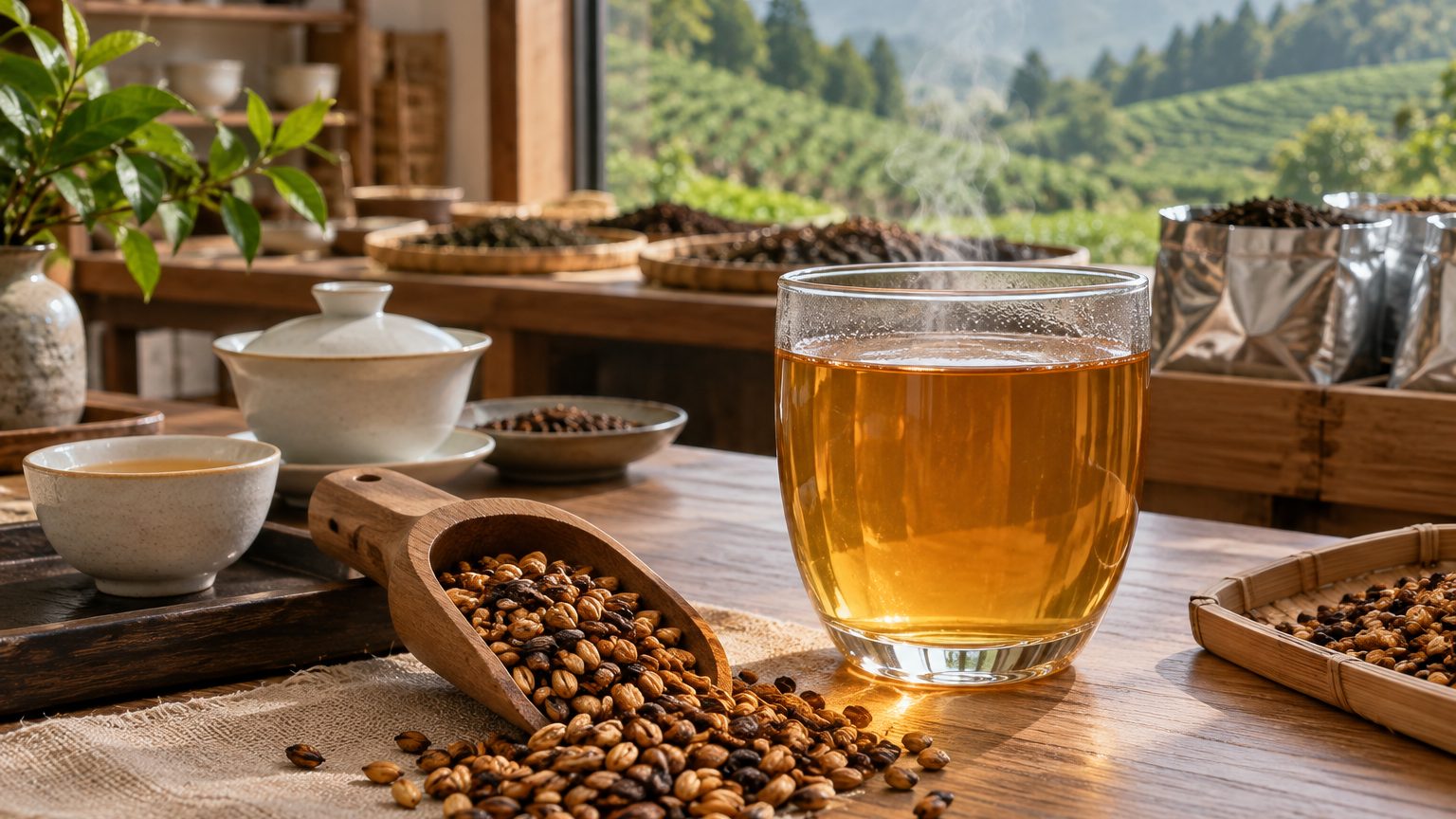
A daily-cup grain infusion with two homelands
Barley tea occupies a position no tea leaf can: the default household drink, drunk hot in winter and cold from the fridge in summer, with no caffeine to time around the day. Korean boricha and Japanese mugicha are the reference habits - in both markets the tea is less a choice than an infrastructure, the thing that is simply in the kettle. For a buyer that means steadier, less seasonal demand than most specialty teas, and a customer who judges the product on familiarity rather than novelty. The grain itself is plain barley, roasted; nothing else belongs in the bag. How it fits beside the other caffeine-free lines is mapped on the herbal and grain category page.
The cupping sheet
Grain infusions are cupped with the same five factors as leaf teas, with roast consistency doing the work that leaf grade does elsewhere.
| Factor | Reference points for a clean lot |
|---|---|
| Dry grain | Even, plump kernels with uniform roast color; no burnt, pale or shriveled outliers in excess |
| Liquor | Amber gold, clear; level 3 on the swatch; darker for deeper roasts |
| Aroma | Toasty, biscuit-like grain; no scorch, no mustiness, no stale oil notes |
| Taste | Gentle roasted sweetness, clean finish, no bitterness; the cup stays smooth over long steeps |
| Wet grain | Kernels intact and evenly colored after steeping; no broken char |
Roast level is the whole spec
Two parameters separate lots: roast depth and uniformity. A lighter roast gives the pale, biscuity cup common in Korean-style service; a darker roast pushes toward coffee-adjacent toastiness that some markets prefer cold. Neither is better - but drift between them is the defect buyers actually experience, because a household that liked last season's bag notices when the next one pours darker. The desk locks a roast reference with the golden sample and cups every lot against it, so the third shipment pours like the first. Grain size and foreign-grain content are checked alongside, since filling machines and steeping bags both behave differently on uneven material.
Where the volume is
Grocery and Asian-food retail carry the largest packs - the format is a family bag meant to be boiled or jug-steeped, sold on repeat. Foodservice uses it as the house pour in Korean and Japanese restaurants and, increasingly, as the caffeine-free default on general cafe menus, where a grain infusion solves the evening-dining problem that coffee and true tea share; the program angle is set out under hospitality and cafes. Retail chains doing private label use it as an easy first SKU because the ingredient list is one word and the brew is foolproof - a fit covered under retail and importers. Caffeine-free positioning is the second hook in most listings, and the reasoning is written up in the barley caffeine note.
Brewing at any scale
The reference method is a simmer or a full-boil steep: about 5-10 minutes at 100°C, hot or chilled, and the grain tolerates long contact without turning bitter - a batch can sit in an urn through a whole meal service. Cold brewing works overnight in a fridge jug and is how most households actually make mugicha in summer. For foodservice, the desk supplies brew cards matched to urn volumes so a kitchen can batch without a recipe debate. Pyramid-bag formats run 2-3 g per serve for cup service, a format handled through the filled pyramid program.
Program mechanics: MOQ, packing, documents
Bulk roasted grain follows the desk's standing reference range of 50-100 kg per item, with the binding figure confirmed in writing per program on the MOQ and lead time page. Large family packs are a packing program of their own - barrier liners against stale-oil notes, since roasted grain is as sensitive to fat oxidation as it is to moisture. Roasted grain also carries a trace of natural oils, so freshness has a calendar: stock rotates, liners stay sealed until packing, and lots are dated on the record. Old grain reads as flat toast before it reads as anything wrong, which makes rotation discipline the highest-leverage quality tool on this line. Standard lab panels issue per batch, and roast references are retained for comparison across seasons. If the market is Korea- or Japan-adjacent, tell the desk the roast expectation in words or sample form at the start; it is the one input that changes everything downstream. Send the brief to the quote desk with pack size and channel, and a sample plan comes back in writing.