
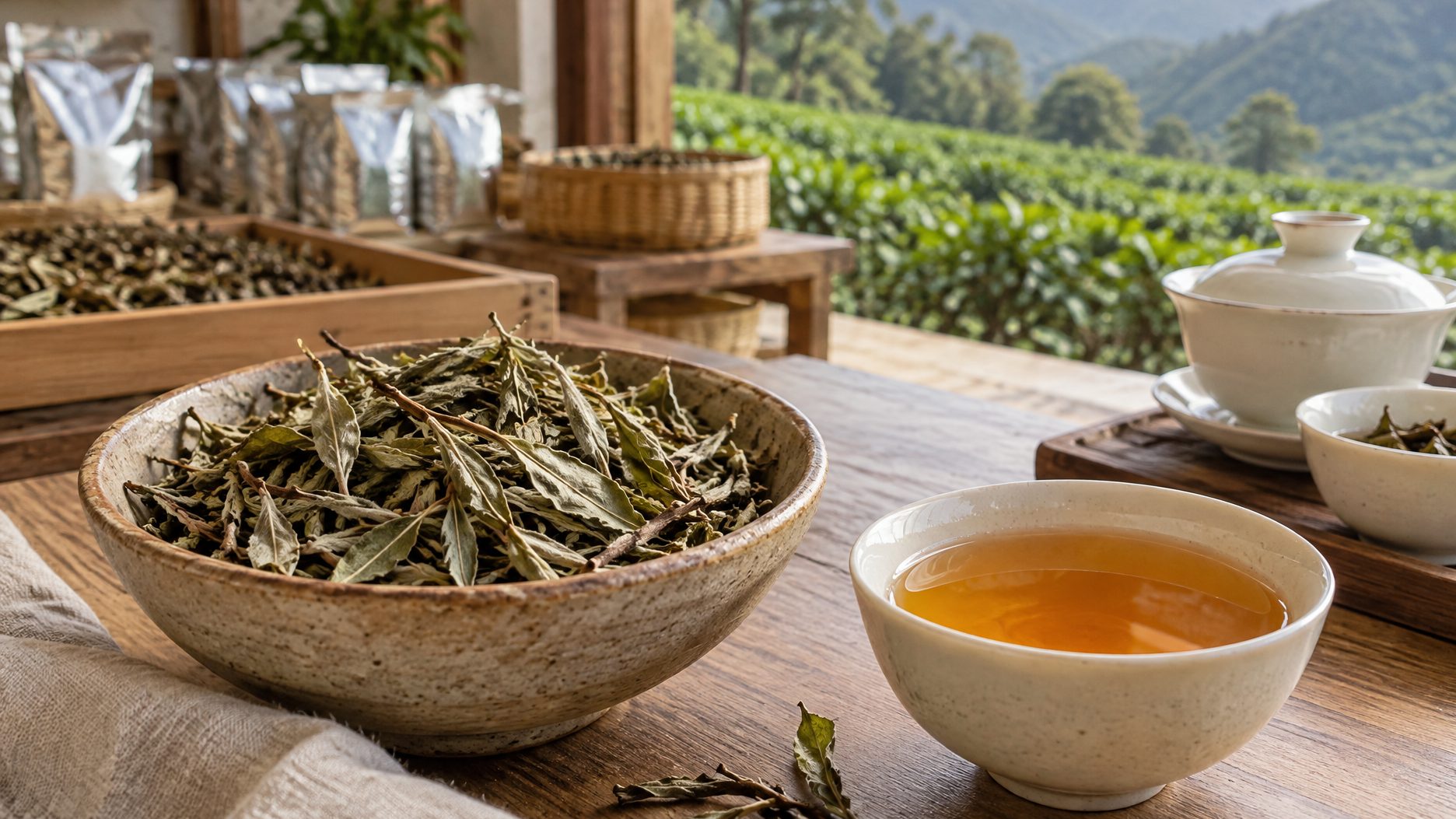
Where gongmei grows: Fuding and Jianyang
Gongmei comes from the crowd variety - mixed local seedling stock rather than a single cloned cultivar - picked as one bud with two to three leaves. Its home ground is northern Fujian: Fuding on the coast, the county most white tea is named after, and Jianyang inland, which has its own long white-tea history. Terroir there runs to fog, acidic gravelly soil and a long mild growing season, and the same minimal processing turns out noticeably different material in warmer districts to the south. That is why lot records here state the county, not just the province. Against the bud-only Silver Needle and the balanced White Peony, gongmei carries more leaf and stem: fuller body, deeper color, lower raw-material cost. The white tea category page lines up all four so the choice is a deliberate one.
How it is made: withering and drying, nothing added
White tea processing is the shortest in the trade: pick, wither, dry. No pan-firing fixes the leaf, no rolling breaks it open; enzymes work slowly through a one-to-three-day wither and the leaf dries where it lies. Most of the cup is decided in that wither - slow and even builds the melon-sweet, cooked-herb character, while a rushed or humid wither leaves grassy harshness that no later step removes. Gongmei's thicker, tougher material tolerates a slightly faster schedule than bud teas, one reason it prices where it does. After drying the lot is sorted and graded; a share is pressed into cakes on the same weigh-steam-press-dry line used for pu-erh, wrapped in food-grade cotton paper for aging programs or shelf presence. Nothing is flavored, nothing is smoked - the style lives or dies on leaf quality and wither discipline.
The cupping sheet
| Factor | Typical gongmei | What the buyer watches |
|---|---|---|
| Dry leaf | Mixed gray-green leaves, silver-tipped buds, some stems | Even color; scorched red-brown edges point to rushed drying |
| Liquor | Orange-yellow, clear and bright | Dullness suggests age or poor storage |
| Aroma | Cooked herb, honey, faint dried flower | Mustiness means a bad wither; smoke means bad firing nearby |
| Taste | Sweet, round, soft, low bitterness | Sourness indicates overheated drying |
| Wet leaf | Brown-green, pliable, mostly whole | Heavy fragmentation means rough handling |
Every lot is cupped on the five standard factors - dry leaf, liquor, aroma, taste, wet leaf - under the national sensory method (GB/T 23776), and the sheet ships with the sample so bulk is judged against the same paper.
Brew parameters that hold on a menu
| Format | Dose | Water | Time |
|---|---|---|---|
| Gaiwan or small pot | 5 g / 110 ml | 90-95°C | Short pours, repeated |
| Western cup or pot | 5 g / 150 ml | 90-95°C | 2-4 minutes |
| Aged cake, boiled service | 5-6 g per 600 ml | Full boil | Simmer a few minutes |
The leafy cut rewards heat and patience: below about 85°C the cup turns thin and the herb sweetness never opens. These are typical reference ranges - the written spec per program may tighten them, and on-pack directions are matched to the format actually sold.
Who buys gongmei, and for which shelf
Gongmei earns its slot in four recurring scenarios. Retailers building a white-tea wall use it as the approachable everyday line under Silver Needle and White Peony, where the story is honest value rather than rarity. Hotels and restaurants like it because it forgives service: long steeps in a thermal pot round it rather than wrecking it. E-commerce sellers press it into cakes and gift boxes where the price-per-gram still leaves margin after artwork. And blending programs take it as a base when a mild white character is wanted under fruit or florals. Tea houses chasing rare lots are the wrong audience and the desk says so; that honesty is cheaper than a disappointed program. If the brief is white tea for volume, this line usually answers it.
Private label and packing
Formats split three ways. Loose leaf ships in foil-lined pouches or bulk aluminum bags inside cartons, with a nitrogen-flush option for long retail lanes. Cakes run 357 g wrapped in cotton paper, sleeved or boxed per artwork. The leafy cut also fills pyramid bags well - it is exactly the kind of material bag machinery handles without shattering - which makes the line a natural companion to the pyramid bag program. Labels are produced to destination-market food rules: ingredient, net weight, origin, best-before. MOQ follows the desk's typical reference ranges for bulk and private-label packing - the binding figures are set in writing per program on the MOQ and lead time page, and artwork logistics run through the private label process.
Season and the buying calendar
Like all white tea, gongmei is a spring harvest first: leaf is picked and withered in spring, and the year's fresh lots reach packing in the following weeks. Unlike green tea it does not collapse with time - a well-stored lot holds through the year, and deliberately aged lots are a separate story - so programs can buy against stock calendars rather than against a narrow shipping window. What does move is quality by season and price by outturn; the desk cups new lots against the standing reference and flags drift before it reaches your customers. Programs that sell aged material plan differently, and the storage side of that is covered under grading and storage.
What to check before bulk
- Harvest year and storage history - current-season and aged lots are different programs.
- Cup against the approved reference on all five factors, not aroma alone.
- Moisture and pack integrity; foil liners sealed, cakes wrapped without cracks.
- Lab panel per batch from a third-party laboratory, issued in your name.
- For pressed material: cake weight, shape and paper condition on arrival.
If the profile is a sweet, leafy white for daily drinking, send it to the desk and get a sample plan and written offer back.