
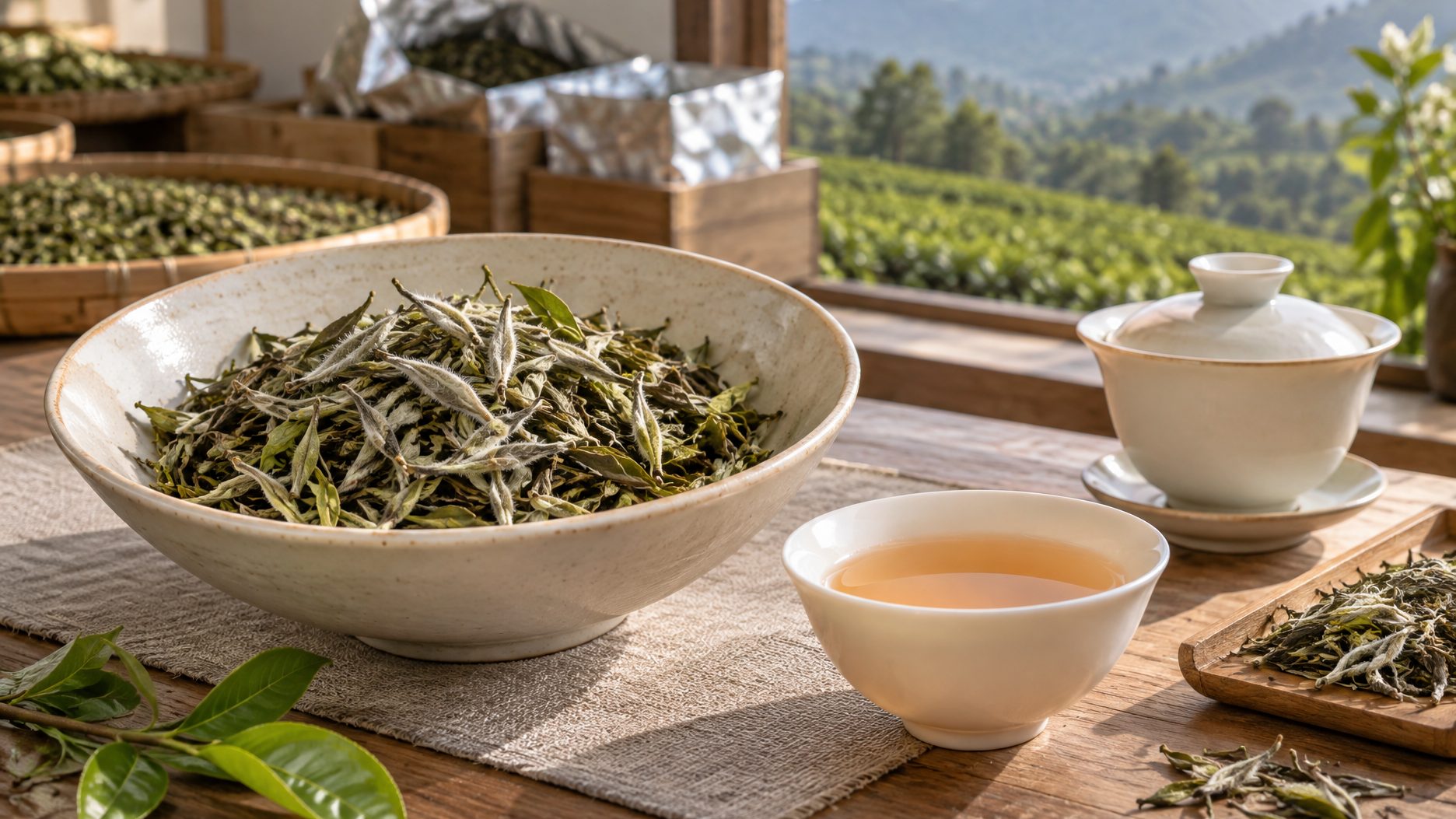
What White Peony is
White Peony - bai mu dan in pinyin - is picked as one bud with one or two leaves, which places it one step down the picking ladder from Silver Needle and several steps up from the leaf-only grades. That composition is the tea's whole personality: the bud contributes the down and the quiet sweetness, the leaves contribute the florals and the body, and together they make a cup more expressive than needle and far more forgiving to brew and to serve. The name is usually explained by the way the open bud-and-leaf sets resemble the flower; the trade shorthand is simpler - it is the white tea people drink daily. If you are building a white tea range, this is the volume line and needle is the halo above it.
Terroir and picking
The tea comes from the same two Fujian counties as the rest of the category's top material: Fuding on the coast, Zhenghe inland. Spring is the season that matters, and picking runs through the weeks when the bud-and-leaf sets are at the right stage - too early and the leaf is missing, too late and the set coarsens. Within the season, lots separate on bud share, leaf tenderness and the evenness of the sets, and a higher bud share reads as a visibly silvier dry leaf. The desk records origin, county and maker per lot; the sourcing structure is the one described on the white tea category page and its origin-network backing.
Processing: minimal by design
The process is the white tea constant: wither and dry, no firing, no rolling. With more leaf in the mix than needle, withering has more material to work through, and the craft shows in the cup as floral lift rather than flatness - the aroma compounds the trade hears as white peony's florals are the leaf's own, preserved rather than added. Because nothing covers up mishandling, the desk's lot records carry process notes alongside origin, and incoming lots are cupped before they are praised. The same minimalism is why the category is one of the few that genuinely changes with age, which the next sections turn into a buying decision.
The cupping sheet
| Factor | Young lot | Aged lot |
|---|---|---|
| Dry leaf | Buds with green-grey leaves, down visible | Darker leaves, down faded |
| Liquor | Apricot, bright | Deeper amber-apricot |
| Aroma | Fresh floral over pekoe | Honeyed, dried-fruit, soft herbal |
| Taste | Soft florals, clean sweetness | Rounder, deeper, mellow |
| Wet leaf | Green-brown, pliable sets | Brown, soft, even |
Both columns are legitimate products; they are different shelves. The desk keeps references for both states so a program can choose its lane deliberately instead of discovering age in a customer review.
Brew parameters
| Parameter | Reference |
|---|---|
| Leaf to water | 5 g / 150 ml |
| Water temperature | 90°C |
| Infusion | About 3 minutes; shorter rounds in gongfu service |
| Service fit | Pots, gaiwans and large-format service - more forgiving than needle |
The extra leaf makes the line the practical white tea for hospitality: it survives slightly hot water, slightly long steeps and busy staff better than bud-only material does, while still reading as premium. Aged lots brew similarly but reward water a touch hotter; the desk states the per-lot parameters on the sheet so service teams are not guessing.
Young or aged: two shelf strategies
White tea is one of the few categories that improves in the bag, and White Peony is the grade where that fact becomes a business choice. Sell young and the florals are the pitch - a spring-fresh story with immediate drinkability. Hold lots and the cup deepens toward honey and dried fruit over a few years, and the trade pays for that depth; the mechanics of what changes and why are in the white tea aging guide. Programs that want the aging story without the warehouse time take the leaf-heavy grades below - Gongmei and Shoumei are the classic aged grades - and keep Peony young. The desk's advice is to pick one lane per SKU; a pack that claims both usually delivers neither.
Programs, private label and buyer checks
Retail is the natural home: an approachable price point below needle, a visible leaf that reads well in pouches, and a story simple enough for shelf talkers. Hospitality pours it as the white option by the pot. E-commerce bundles pair it with needle as good-better. Private label follows the standard ladder on the private label page - bulk first, retail formats at their own tiers, artwork and destination-market labels per program - and packing choices from kraft-foil pouches to nitrogen-flushed formats are on packaging options. Buyer checks before bulk: bud share and set evenness against the sheet, the five-factor cup against the golden sample in the chosen young-or-aged lane, moisture, the per-batch lab panel, and pack integrity. The quote form opens the file; samples come first, bulk comes second, in that order.