
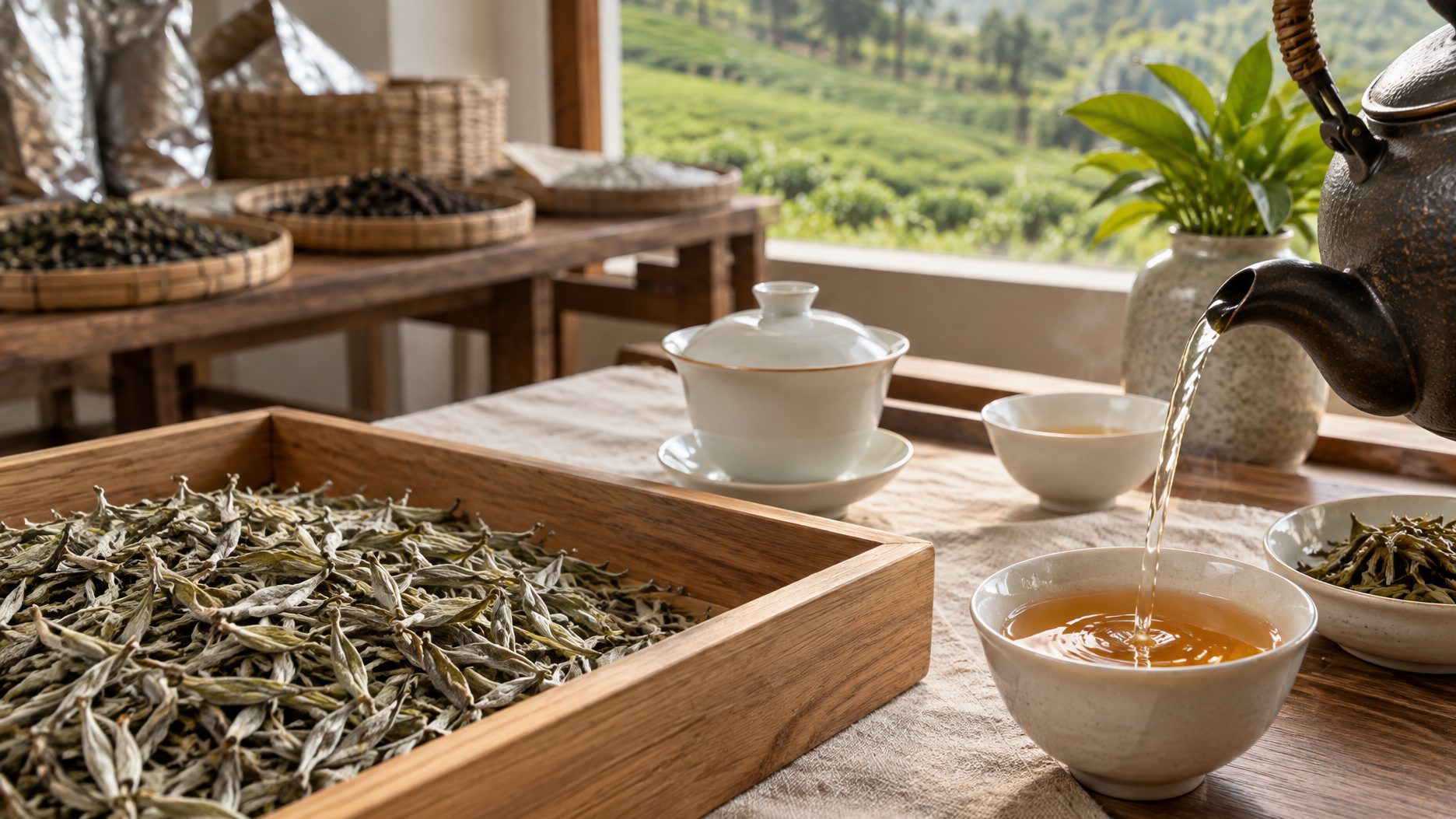
Fuding origin and the leaf standard
Shoumei comes chiefly from Fuding in Fujian, the coastal county where the white tea trade centers. Its picking standard is the loosest in the category: mostly mature leaves with prominent stems, taken later in the season than the bud lines. Read that as a feature, not a defect. Stems and coarse tissue carry their own sugars and aroma precursors, which is why shoumei brews thicker and sweeter than its plain appearance suggests, and why it stands up to boiling water that would punish a Silver Needle. Within Fuding, micro-differences in hillside, fog and withering halls show up clearly in this line because there is no roasting or scenting to mask them. Lot records state county and season for that reason; a buyer comparing two shoumei offers is usually comparing two different withers as much as two different farms. The category page shows where this line sits against Silver Needle, White Peony and gongmei.
New shoumei versus aged shoumei
Shoumei is the white tea most deliberately bought for aging, and the two ends of the curve taste like different products.
| Factor | New shoumei | Well-aged shoumei |
|---|---|---|
| Dry leaf | Gray-green, broad, stemmy | Deep brown, slightly glossy |
| Liquor | Amber gold, clear | Orange-red, thick |
| Aroma | Hay, dried flower, melon | Jujube, bamboo leaf, dried herb |
| Taste | Sweet, soft, lightly grassy | Round, honeyed, dried-fruit depth |
| Wet leaf | Olive-brown, pliable | Dark brown, still intact |
Programs can stock one end or both: new shoumei as an everyday affordable white, aged shoumei as a story-driven premium where the years are part of the pitch - provided the storage record backs the story.
Brewing and boiling parameters
| Service | Dose | Water | Time |
|---|---|---|---|
| Gaiwan, new shoumei | 5 g / 110 ml | 95-100°C | Short pours, repeated |
| Pot, retail direction | 5 g / 150 ml | 95-100°C | 3-5 minutes |
| Boiled, aged cake | 5-6 g per 600 ml | Full boil | Simmer briefly, repeat |
Boiling is the signature move for aged shoumei: the thick tissue releases slowly, and a short simmer yields a jujube-sweet liquor that stays smooth where thinner leaf would turn bitter. Cafes use it for winter lists; hotels use it for self-service stations where a pot sits long. These are typical reference ranges, matched to the format on the written spec.
Aging is storage, not a label
An honest word, because aged white tea attracts loose claims: white tea changes over years only if it is stored well the whole way - cool, dry, dark, away from odors, in breathable paper rather than sealed plastic. Heat and humidity age a tea badly, not well; a damp warehouse gives mustiness, not maturity. So the desk sells aging on documents, not vibes: lot records state production season and packing date, storage conditions are stated plainly, and where a program wants genuine aged character without waiting years, it is bought as aged stock from vetted lots with their history on file. What the desk does not do is dress young material as old. Buyers who want the full mechanics will find them in the white tea aging guide and the storage pages under grading and storage.
Who buys shoumei, and for which occasion
Retailers use new shoumei as the affordable floor of a white-tea wall and aged cakes as the high-margin storytelling line above it. Cafe and restaurant programs like the boiled service for cold-weather menus - a pot of jujube-sweet liquor reads seasonal without any flavoring added. E-commerce sellers bundle small cakes with simple brewing instructions, since shoumei tolerates beginner mistakes better than any other white tea. And gifting programs take pressed cakes in presentation boxes where the wrapped cake itself is the design. Tea houses chasing rare bud lots are not the audience here; volume, warmth and patience are. The pattern across repeat orders is simple: shoumei is the white tea people actually drink daily, which is exactly what keeps programs reordering.
Private label and packing
The cake is the hero format: pressed, cotton-paper wrapped, sleeved with your artwork, and packed into gift boxes where the program calls for it. Loose leaf ships in foil-lined pouches for everyday lines; the leafy cut fills pyramid bags cleanly for single-serve programs. Aged lots are packed with their storage history in the lot record so your label copy stays defensible. Labels follow destination-market food rules - ingredient, net weight, origin, best-before - produced through the private label workflow. MOQ runs on the desk's typical reference ranges per format, confirmed in writing per program, with the calendar and cost steps laid out under MOQ and lead time. Packing options, from kraft pouches to gift cartons, are compared on packaging options.
What to check before bulk
- Production season and packing date on the lot record, before any aging claim is written.
- Cup new and aged references side by side so the program knows both ends.
- For aged lots: storage history in writing, not just a year printed on a wrapper.
- Cake weight, shape and paper condition; loose moisture and seal integrity.
- Lab panel per batch from a third-party laboratory, issued in your name.
Whether the brief is a daily drinker or a five-year story, send it to the desk and get samples of both ends of the curve.