
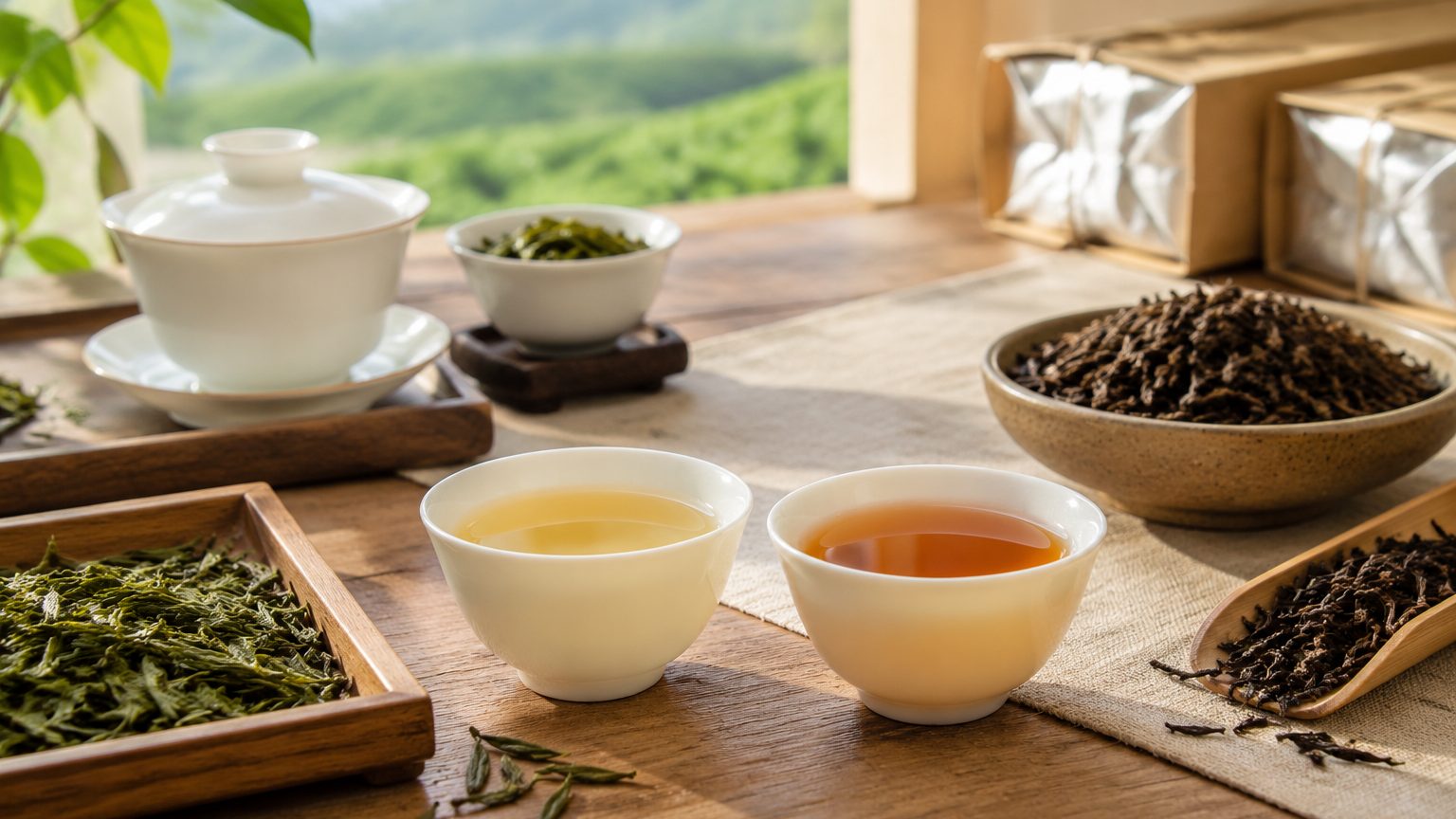
The short answer
Raw and ripe pu-erh come from the same plant in the same province, and that is roughly where the similarity ends. Ripe pu-erh is fermented on purpose: the leaf is moistened, piled and allowed to ferment under managed heat and moisture, a process the trade standardized in 1973, so the tea arrives dark, smooth and ready to drink now. Raw pu-erh is sun-dried maocha steamed and pressed into cakes, then left to age the slow way, in storage. One cup is chestnut-red, thick and settled; the other starts yellow-green and sharp-edged and drifts toward orange and roundness over years. They are not two grades of one product. They are two lines with separate buying logic, and treating them as interchangeable is the most common mistake buyers make in the category.
Processing: the pile versus the warehouse
The fork happens right after the leaves dry. For ripe pu-erh, processors wet the maocha, build it into large piles, and manage temperature and moisture so microbial fermentation runs its course over weeks - the wet-piling process whose modern form dates to 1973. The pile is turned, watched and stopped at the intended depth, after which the leaf is typically pressed into the familiar 357 g seven-piece cake format. The result is transformation achieved inside the factory, on a schedule. Raw pu-erh skips all of that: sun-dried green maocha is steamed, pressed and wrapped, and everything that later changes about the tea happens wherever the cake is stored. That transfers the change from the maker to the holder, which is why storage advice for raw cakes is a purchasing question rather than an afterthought - the storage note for pu-erh cakes covers what a buyer needs to control. The mechanics of the pile itself, and why it produces such a different cup, are laid out in the wet piling explainer.
Cup by cup
| Aspect | Raw pu-erh | Ripe pu-erh |
|---|---|---|
| Made by | Sun-dried maocha, steamed and pressed | Wet-piled fermentation, then pressed |
| Liquor | Yellow-green, moving to orange-yellow with age | Chestnut red, dense and deep |
| Taste arc | Gentle bitterness that returns as sweetness | Aged aroma, thick and glutinous-smooth |
| Drinking window | Drinks now, keeps changing in storage | Ready on release, softens further with rest |
| Where change happens | In the warehouse, over years | In the pile, before pressing |
The two cups serve opposite moods. Raw is a tea with an argument in it - lift, edge, a finish that keeps moving - and its audience tends to be people who enjoy the movement itself. Ripe is a settled cup with no rough edges to manage, which is exactly why food-service programs reach for it first.
Brew routines side by side
| Parameter | Raw | Ripe |
|---|---|---|
| Leaf and vessel | Flaked from the cake, gaiwan or pot | 5-7 g / 110 ml gaiwan |
| Water | 95-100°C | 100°C |
| First pour | Short, judged by taste | A rinse, poured off once |
| Shape of the session | Rounds that shift as the cake opens | Even, dark, repeatable rounds |
The rinse on ripe cake is not superstition: it wakes the compressed leaf, and the first pour carries loose dust and any storage flatness, so the second cup is the honest one. Raw cakes also get short early pours, but the drinker is following an arc - bright rounds, then fuller ones, then late sweetness - rather than holding a flat profile. Both teas take boiling water and hard water without complaint, one reason they suit venues without temperature-controlled kettles.
Which channels fit which line
Ripe pu-erh is the service workhorse: dark enough to read clearly through milk and sugar, smooth enough to survive a thermos, and repeatable from batch to batch when blending is disciplined. Bubble tea menus, hotel buffets and cafe pots are its natural ground, and chenpi pu-erh - ripe tea paired with tangerine peel from Xinhui in Guangdong, either blended or packed whole-fruit style - gives the same base a flavored story without a new brew routine. Raw pu-erh belongs where the drinker has ten minutes and some curiosity: tea houses, specialist retail, subscription boxes and the collector-leaning end of e-commerce. It is the line that turns a menu item into a conversation, and the line whose cup you taste differently every year if storage is right. Retailers often carry both and position them apart: ripe at the counter where speed and consistency rule, raw on the shelf where the story sells. The pu-erh category page shows how the two sit together in one catalog.
What drives the price gap
The ladders price different things. Raw pu-erh is priced by place and year: leaf from a named mountain or village, from a specific spring, with a storage history that can be told and checked - and every year a cake rests in good storage, the inventory holding it represents cost as well as character. Ripe pu-erh is priced by process: the quality and uniformity of the pile, the blending behind a batch, and how repeatable that batch stays across production runs, because a food-service buyer is really purchasing the ability to re-order the same cup next quarter. Neither ladder translates into the other's currency, so quotations should be compared within a line and a tier, never across them. Cake formats, lead times and typical reference order sizes are set out on the MOQ and lead time page, and final terms are confirmed in writing for every program. Ask how a lot will be re-supplied, too: raw cakes repeat by year and village, ripe blends repeat by recipe, and the answer tells you which kind of continuity you are actually buying.
Choose raw if, choose ripe if
Choose ripe pu-erh if you serve volume: cafe pots, milk-tea bases, hotel service - any program where the same cup must repeat tomorrow and next month, and where a flavored bridge like tangerine-peel pu-erh helps the menu tell a story. Choose raw pu-erh if your customer buys the journey: tea houses, enthusiast retail, subscriptions and collectors, provided you are prepared to talk about storage honestly, because with raw cakes storage is part of the product. Many catalogs carry both and never let them compete on one shelf. To compare the lines on your own terms, request cakes from each through the quote form, cup them back to back in your own water, and decide which cup your customers are actually asking you for.