
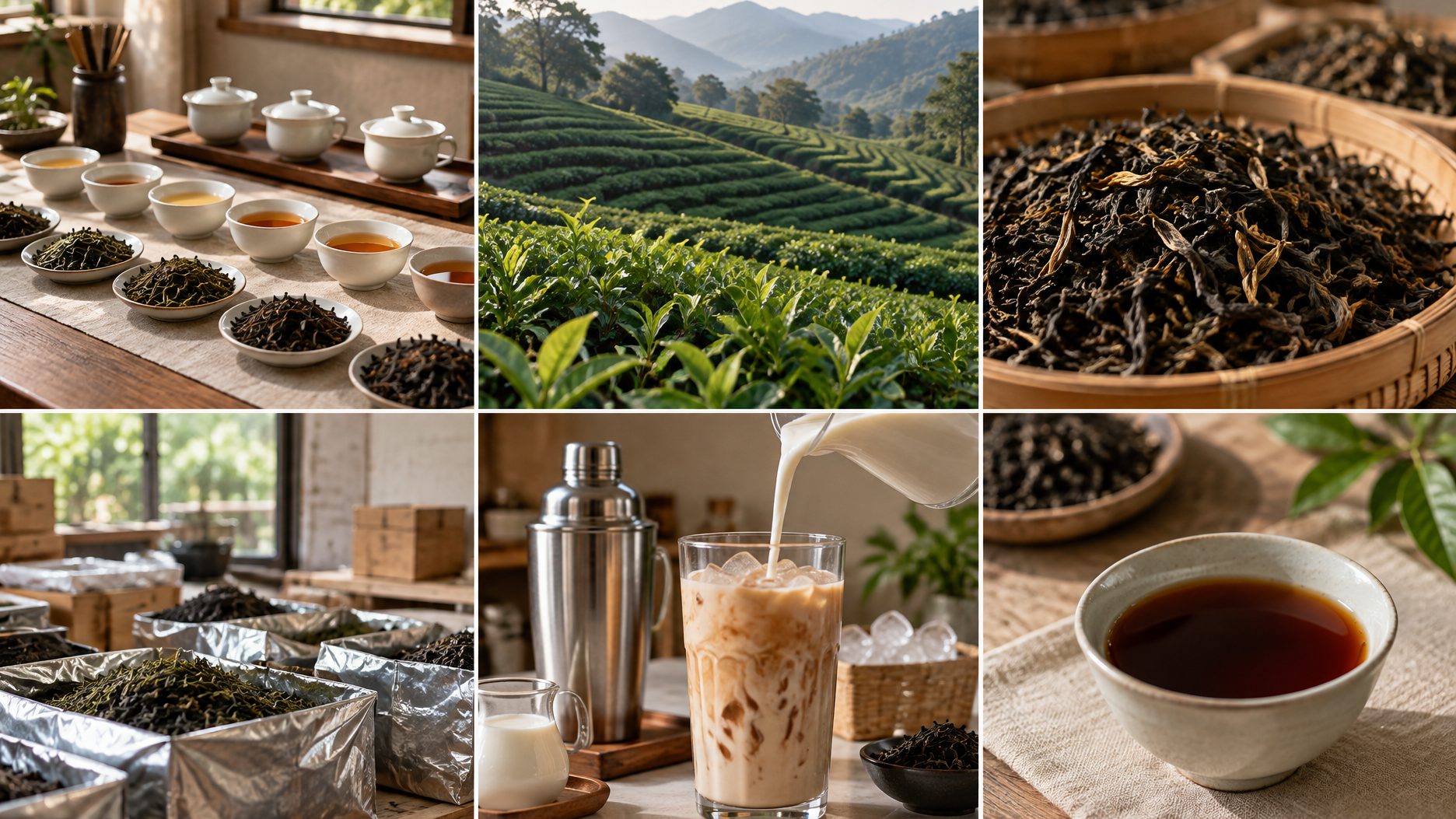
What a milk tea base actually has to do
A tea base in a bubble tea cup faces an extreme brewing test. It is extracted hot and strong, then chilled over ice, then sweetened, then diluted with dairy or a non-dairy creamer. Weak tannin structure disappears entirely; harsh tannin turns abrasive against sugar. The base needs body that survives chilling, color that stays red-brown instead of graying, and enough amplitude that the drink still reads as tea at the third sip. Industry reports estimate bubble tea at around 3.3 billion US dollars in 2025, growing well above the tea average (Grand View Research, 2025) - which is why base failures repeat so loudly: the drink is the brand. This page is the desk's program for getting a base specified, locked and repeated.
The four lines, and when each one fits
| Line | Role in the menu | Why it works through milk and ice | Format note |
|---|---|---|---|
| CTC black tea | The volume base for classic milk tea | Cut leaf extracts fast and red at 100°C; strong, clean, no leafy edges | Bulk foil bags; brew anchor 2-3 g / 200 ml, 3-5 minutes |
| Yunnan Dianhong | Flavor-forward black for signature milk teas | Large-leaf material with honeyed strength; more aroma than CTC alone | Bulk or packed; pairs with CTC in a two-base system |
| Jasmine tea | The scent-forward SKU family | Green base scented with fresh flowers over repeated rounds; aroma survives sweetening | Bulk for brewing; pyramid filling for retail spin-offs |
| Matcha powder | Whisked or shaken straight into milk | Food-grade, milled to spec; color and particle size are the control points | Foil tins and pouches; nitrogen option for color stability |
Import origin teas join the bench when the brief calls for them: Assam and Ceylon arrive through compliant import channels and are cupped side by side with the Chinese lines, because a milk-tea base is chosen on the cup, not on the flag. For most programs the honest answer is a two-base system - a workhorse CTC for the menu's volume SKUs and a flavor-forward black or jasmine for signature drinks - which keeps procurement boring and the cup consistent.
Blend consistency: the golden sample system
Blend drift is the failure buyers taste before the invoice explains it. Tea is agricultural; harvest outturn moves, and a base blended 'to taste' will drift with it. The desk's counter is procedural, not verbal: the approved sample is sealed as the golden sample and both sides hold a copy; every production batch is cupped against the seal on the five factors before shipping; any substitution of component leaf requires written approval against the sealed sample. Batch samples are retained so a question six months later can be answered with tea, not memory. That is what blend customization means here - a profile defined once and defended on every batch.
Cost stability and harvest planning
A base program is a calendar exercise as much as a cup exercise. Black tea lines for milk applications move with each season's outturn; jasmine is scented in summer rounds against its green base; matcha demand has been growing faster than supply, an industry context reported alongside the market numbers (Grand View Research, 2025). The desk plans backwards from your menu: standing volume is booked against the season, reserve stock is held for year-round SKUs, and when an outturn runs short you hear it with options - a forward lot, an approved substitute against the golden sample, or a schedule change - not after a shipment. The buying calendar explains the mechanics; the desk runs it for you as part of the program.
Packs, documents and compliance for beverage programs
Bases ship in foil-lined bags inside cartons, with nitrogen flushing available for aroma-critical lines; pyramid filling is available when a brand wants bottled-tea or retail spin-offs from the same spec. Documents match what a beverage plant's QA team and your import market need: spec sheets and ingredient declarations, packing dates on lot records, third-party lab panels per batch for pesticide residues, heavy metals and microbiology, issued in your name. FDA food facility registration applies to US-bound programs, and EU MRL work follows Regulation (EC) No 396/2005 as amended. Organic claims are made only on certified material with the certificate chain verified per program. The full list lives on certifications and quality control.
From sample to shaker
- Send the brief: drink applications, dairy type, sweetness level, intended strength in your recipe.
- Receive samples with cupping notes; brew them inside your own recipe, not just straight.
- Lock the golden sample; adjust the blend until the shaker test passes cold and sweet.
- Bulk runs against the seal with inspection before packing; reference entry: bulk 50-100 kg per line, pyramid filling at around 100,000-bag scale.
- Lead time references: samples 3-7 working days in stock, 7-15 for custom blends; bulk 10-15 working days for in-stock lines, 35-60 days for new blends.
These figures follow the desk's standing references; the full tables sit on MOQ and lead time, and a base program starts with a written reply from the quote form, usually within two working days.
An illustrative case, generic on purpose: a two-city brand grows from one milk tea SKU to four and finds its original base drifting between seasons. The desk rebuilds the base as a documented CTC-Dianhong blend, seals the golden sample, and holds reserve stock behind the jasmine program - the drinks stop changing between deliveries, which is the entire point. Illustrations like this appear on case studies without client names or program figures; real numbers stay in the written offer.