
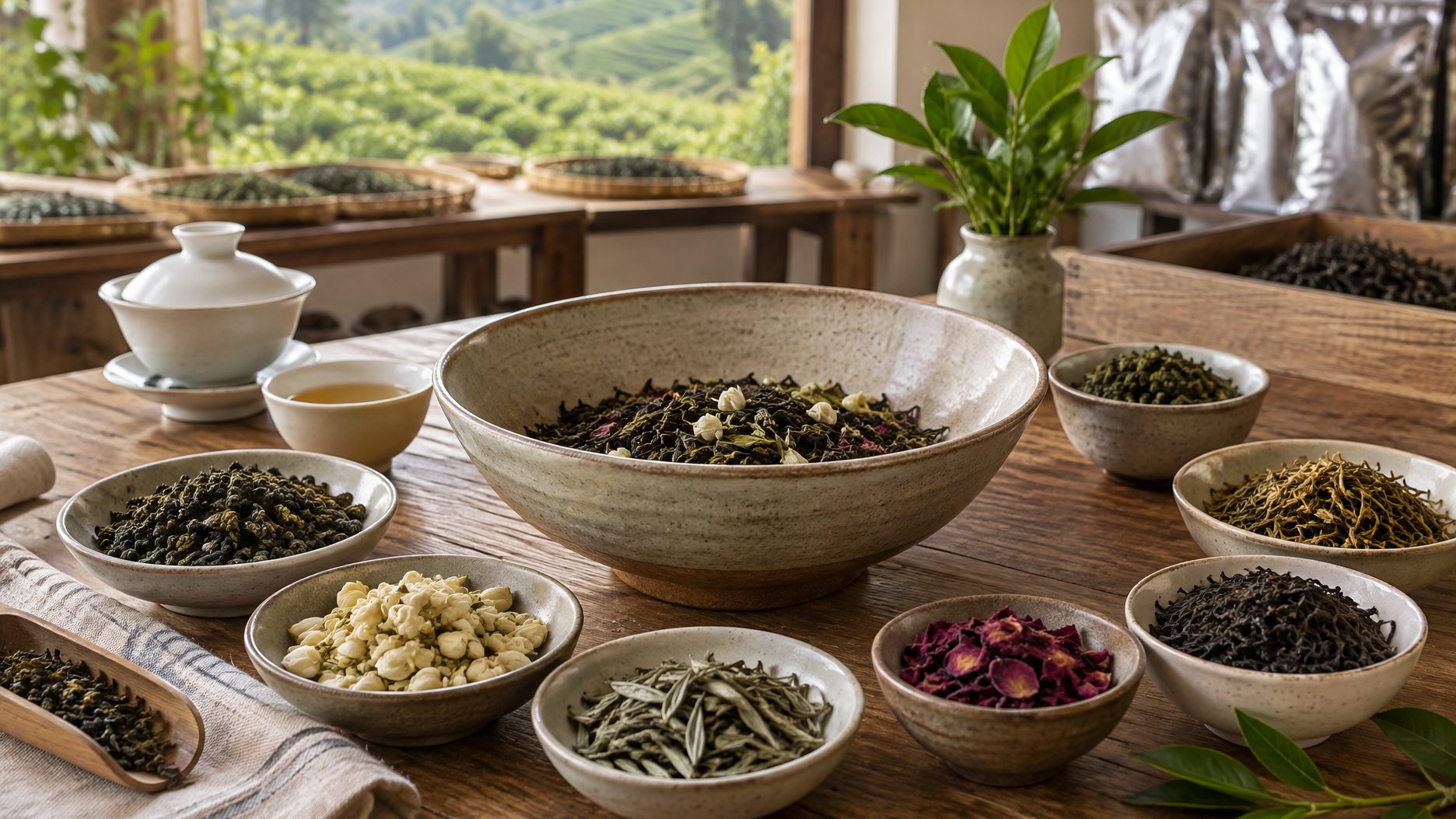
Why blending is the desk's core craft
Single-origin lots are agriculture: they change with the season whether anyone wants them to or not. Blends are the industry's answer - component teas married so the cup stays the same while the harvest moves underneath. That is why blending sits at the center of this desk rather than at the edge: bubble tea brands need a base that extracts identically every week, hospitality programs need a house black tea that survives a menu rewrite, retail brands need the pouch on reorder to taste like the one that built the reviews. The desk coordinates partner facilities for the components and runs the blending discipline itself - the brief, the trials, the lock, the checks - so the taste belongs to your brand, not to one farm's weather.
Step one: the cup-profile brief
Every blend starts as words on a sheet, and the brief is where most programs are won. It records, in terms a bench can act on: body and strength (how the tea stands against milk, ice or a long steep), aroma type and intensity (floral, roasted, malty, citrus - and how loud), liquor color aim, bitterness and astringency tolerance, sweetness impression, and the formats it must work in - loose leaf, pyramid bag, cold brew, or all three. A useful brief also names what the cup should not do: no smoke, no high grassiness, no perfume edge. Buyers rarely have tea vocabulary at the start, and none is required - "a breakfast tea that cuts through oat milk without going bitter" is a perfectly good opening, and the desk translates it into component candidates and ratios for the first trial.
Step two: blend trials
Trials are run at weighed ratios on the bench: candidate components - a Keemun for perfume, an Assam for strength, a CTC for body, a Dianhong for honey color - are portioned, blended, brewed under the program's reference parameters and cupped against the brief, then adjusted by ratio, component or grade until the cup lands. Trials typically converge in a few rounds; the honest variable is not skill but trade-offs, because strength, aroma and price pull in different directions and the brief's priorities decide which one yields. When a candidate iteration fits, it is sealed as the golden sample and the program moves to bulk. Custom flavored and scented work adds a second loop - flavor or scenting application is tuned per batch, then locked the same way. The commercial frame around trials (sample timing, what is chargeable, how bulk follows) is set out under MOQ and lead time.
Flavor and scent options
| Direction | How it is achieved | Typical programs |
|---|---|---|
| Jasmine | Green tea base scented with fresh jasmine flowers in repeated rounds; intensity follows the number of rounds | Retail jasmine, hospitality pots, blend components |
| Roast levels | Charcoal or oven firing passes on oolong bases; depth and repeat passes set toast and body | Roasted oolong programs, house black alternatives |
| Fruit character | Dried fruit pieces and peels in the blend, or a natural flavor application, per market rules | Flavored black lines, iced and cold-brew programs |
| Floral and herbal | Rose, osmanthus-style florals or herbal components blended to the brief | Gifting ranges, caffeine-free lines |
| Smoke | Pine-smoke firing on black base, traditional Lapsang style, dialed from light to assertive | Specialty retail, food pairing menus |
Two honesty notes. Scenting intensity is a real cost variable - more jasmine rounds mean more flowers, more labor and a higher-grade program, which is why the jasmine line spans a range rather than one price. And flavor applications must match your market's labeling rules: what may be called "natural" and how a flavored tea must be named is settled in the label review under private label, before artwork claims something a regulator would strike.
Step three: batch consistency
Consistency is a paper system as much as a tasting skill, and it has four moving parts. First, the blend formula is written down - components, grades, ratios - as a controlled document, so the blend is not a memory in someone's head. Second, every production batch carries a lot record: input lot numbers, blend date, operator, process notes, packing date. Third, retained samples from each batch are stored against their batch number, so any future question can be re-cupped from the actual leaf. Fourth, every batch is cupped against the golden sample before shipping on the five factors described under quality control, with substitution of any component requiring your written approval against the reference. Together these make the blend auditable end to end - the discipline behind blend consistency that repeat programs quietly depend on.
Seasonal adjustment, planned in advance
Harvests move: a spring green is vivid in April and settles by autumn, an autumn oolong sings differently from its spring sibling, and a drought year shifts a whole region's outturn. The desk's answer is a written adjustment strategy agreed per program before each season: which components are harvest-locked (fresh greens usually are), which are stock-buffered (roasted oolongs, pu-erh, CTC bases hold well), what the re-cupping plan is when new-season components land, and who approves a formula tweak if a component drifts. When a change is needed, it is proposed with side-by-side samples - current golden sample against candidate new-season blend - so the decision is a comparison, not a surprise. Programs that plan this way reorder without anxiety; programs that do not usually discover their "consistent" house tea changed in a customer review.
What a first engagement looks like
The working sequence is short and mostly written. You send the brief - channel, market, formats, the cup in plain words - through the quote form. The desk returns candidate components and a trial plan in writing, usually with a reference-MOQ note per line. Trials run and samples ship; you cup, comment, and converge. The golden sample locks; bulk blends against it with per-batch records, retained samples and a lab panel in your name. From there the program lives on the seasonal plan and the reorder check: cup against reference, documents attached, shipped. If the cup you have in mind already exists in the catalog - a CTC base, a Keemun-style black, a fruit line - customization can start from there and adjust, which shortens the trial loop again.