
The short answer
Tea is processed into six types - green, white, yellow, oolong, black and dark (puer sits here) - from one plant, and the types are defined by what the maker does to the leaf, not by leaf color or cultivar. The decisions come in a fixed order: whether to let the leaf oxidize and how far; when to stop that with heat; how to shape it; whether to roast, scent or ferment it further; and how to dry and pack it. Green tea halts oxidation almost as soon as the leaf arrives. White tea barely intervenes at all. Oolong stops oxidation partway, black tea lets it finish, and ripe puer adds a controlled microbial fermentation on top of a finished tea. For a buyer, this matters more than origin romance: every meaningful line on a spec sheet traces back to one of these decisions, and each of them can be named, sampled and held to reference.
One plant, one decision tree
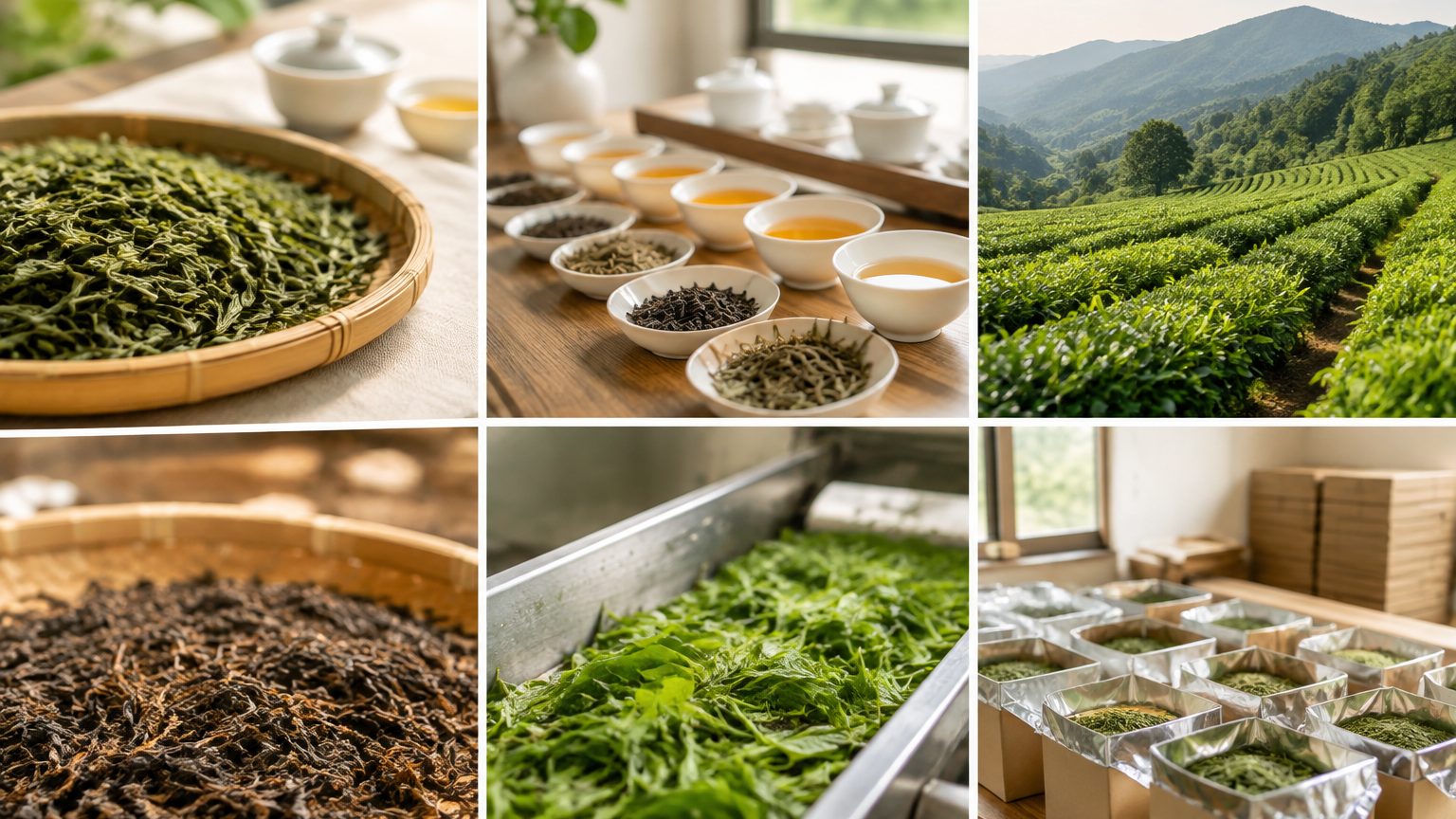
Walk the tree from the top. After picking, the leaf is spread to soften - withering, or spreading in the case of greens. From there the paths split. Green tea goes quickly to a hot pan or a steam bath to denature the enzymes before oxidation can start; Japanese sencha is the steamed branch, most Chinese greens are pan-fired. White tea skips fixing and rolling entirely: the leaf withers and dries, which is why silver needle reads as a list of what was not done. Oolong bruises the leaf edges first - shaking, tossing, tumbling - so oxidation runs to a chosen point, then fixes it. Black tea rolls and lets oxidation complete. Dark tea finishes a green-ish base and then ferments it, in piles or over years of storage. At every fork the maker is trading freshness against depth, and the fork positions are exactly what a buyer should be comparing between suppliers.
The shared spine, step by step
Whatever the type, the working spine is the same, and it is worth knowing because each stage has a failure mode a cupping session will catch.
- Picking. Standard matters: single bud for silver needle and jinjunmei, a bud and a leaf or two for most greens and blacks, more mature leaf for shoumei and much dark tea.
- Withering or spreading. Moisture comes down, leaf turns pliable, grassy sharpness softens. Done badly, the rest of the chain inherits the problem.
- Fixing or bruising. Heat stops the enzymes in greens; tossing starts controlled browning in oolongs.
- Rolling and shaping. Cell structure breaks so the cup extracts; the leaf takes its commercial shape - needle, strip, curve, pearl, flat spear.
- Drying. Stops the clock and sets shelf life.
Puer cakes add their own closing sequence: the finished mao cha is weighed, steamed soft, pressed into shape, rested to dry, and wrapped in paper - the 357 gram seven-cake stack remains the trade convention for a classic bing.
From rough tea to what you buy
Fresh from the primary pass, tea is rough material. What a wholesale buyer actually receives has been through a refining pass: sieving to sort leaf sizes, winnowing to lift out dust and fluff, hand or machine picking to remove stalks and older leaf. Then comes the step the trade quietly considers the most important - blending. Lots from different fields, days or even villages are married to hit one flavor description, batch after batch. After blending, a light roast or aroma-raising pass may follow, and finally packing, usually foil-lined bags inside cartons, with nitrogen flushing available for delicate greens. When the desk describes its production process, this primary-plus-refining structure is what the words refer to.
Why this is a consistency question, not a history lesson
Buyers rarely reorder because a tea was interesting once. They reorder because last spring's container tastes like the sample they approved. Processing discipline is what makes that possible. A supplier who can name their oxidation stopping point, their roast approach and their blend recipe can reproduce a profile; one who sells on adjectives cannot. The trade's own check is the five-factor sensory review - dry leaf, liquor color, aroma, taste and wet leaf - run as a dry pass and a wet pass, with reference samples kept from every batch. China's sensory evaluation standard GB/T 23776 is the public framework behind this. Ask any serious supplier which of those artifacts they keep, and how far back.
What a buyer can actually control
More than most first-time importers assume. Within trade-typical practice, you can specify or at least steer: the oxidation band (clean-green versus roasted tieguanyin is the clearest example); roast level on oolongs and blacks; leaf grade and shape after refining; the blend recipe behind a house profile, locked against a retained sample; packing format, from 5 kilo foil liners to retail cartons, with nitrogen flush where the tea justifies it; and the cake convention for puer programs. None of this makes you a tea maker, but it converts vague requests into checkable lines. The desk's processing guide page shows how each product line's spec sheet expresses these choices. One caution travels with all of it: processing specs hold better as style descriptions pinned to references than as bare numbers. Makers calibrate their own ladders, so a medium roast means what the retained sample says it means - which is why references, not adjectives, do the real work across a program.
Questions to put to a supplier before ordering
- Which steps in the chain do you run, and which do partner gardens run for you?
- How do you record the oxidation and roast decisions for each lot?
- What does your refining pass remove - and what does the grade name mean to you?
- How is the blend recipe documented, and can you hold a reference sample for the program?
- What packing options protect this specific tea - foil liner, carton, nitrogen?
If a supplier answers those five without flinching, processing risk is mostly behind you. If the answers stay poetic, keep shopping. The desk coordinates partner gardens and packing facilities across the origins in its origin network, cup-checks against retained references, and confirms decisions in writing per program. To test the workflow on your own category, send the profile you need to the quote form. For how the six types compare on a menu rather than in the workshop, see the six types overview; and for the sorting pass that turns rough leaf into uniform grades, read the note on sieving and grading.