
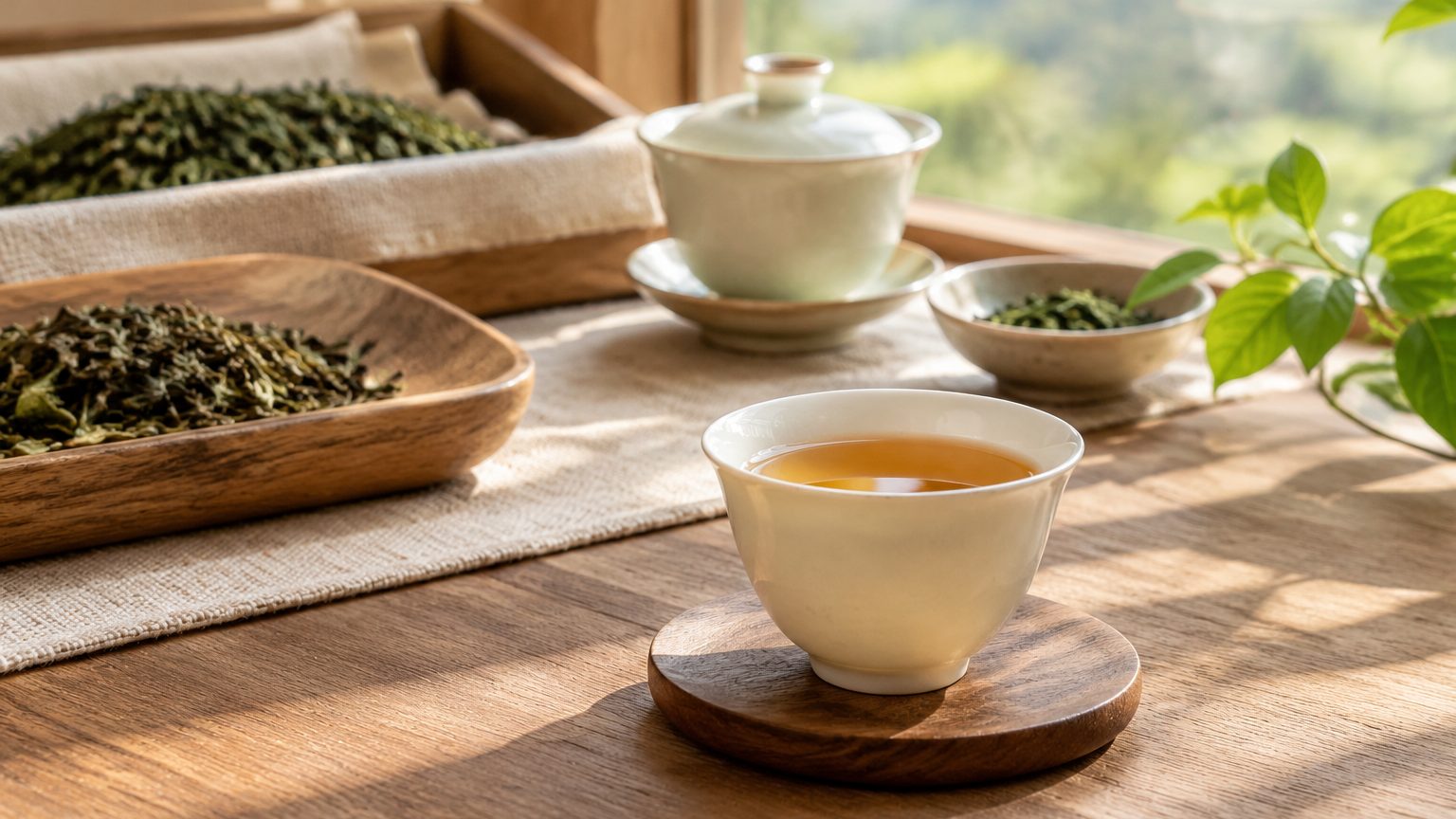
The short answer
Does pu-erh tea help digestion? The honest version of the answer is: it is traditionally drunk with and after rich meals, particularly the fermented ripe style, and generations of drinkers in Yunnan, Guangdong and Hong Kong built that ritual around how the tea feels after food - settling, warming, restorative. What research says is more modest: early studies, mostly in animals or small human trials, have explored fermented tea and metabolic markers, with results that are interesting, inconsistent and nowhere near the certainty a label would need. No tea - pu-erh included - treats, cures or prevents any condition, and rules on health claims vary by market, with most food authorities restricting exactly the wording buyers are tempted to print. So the working position for a program: sell pu-erh on flavor, ritual and the after-meal tradition, describe the evidence as early-stage when asked, and let the tea's genuine qualities - dark, smooth, grounding - do the commercial work.
Where the digestion reputation comes from
The reputation has plausible roots, which is what makes it durable. Ripe pu-erh is made by wet piling - an accelerated microbial fermentation that transforms harsh, astringent sun-dried maocha into a dark, soft, low-astringency cup over weeks; the process and its chemistry are described on the wet piling note. A brew with little astringency, real body and gentle warmth is simply comfortable after a heavy table, and comfort repeated daily for generations becomes tradition. Restaurant culture in Canton and the tea houses of Hong Kong embedded that pattern: dim sum arrives, ripe pu-erh follows. Add the general cultural logic of fermented foods, and a self-reinforcing story forms: fermented tea, heavy meal, feels better, therefore the tea "aids digestion". The feeling is real; the mechanism behind it is where the evidence thins out. A buyer who understands this split - felt experience documented by tradition, mechanism barely charted by science - can answer any customer question without either dismissing the tradition or endorsing a claim.
What research has and has not shown
Summarizing honestly for a commercial audience: published research on ripe pu-erh and related fermented teas includes laboratory work on the chemistry of fermentation, animal studies on metabolic parameters, and a small number of human trials of varying quality - with outcomes that are mixed, effect sizes that are modest where they appear, and plenty of methodological caveats. Researchers have also studied tea drinking more broadly and reported associations with various long-term health markers, but association is not outcome, study populations differ, and no major food authority has approved disease-related wording for tea as a food. That is the whole truth a buyer needs, and it is more than enough: it means you can say the category is being studied, that early findings are intriguing, and that conclusions are not settled - three accurate sentences that together sound more credible than any promise. The desk's rule for program copy is stricter still: nothing on the pack, nothing in the listing, and a trained answer for the inbox. General information yes; implied outcomes no.
Tradition, claims and the line between them
| Statement | Status | Where it belongs |
|---|---|---|
| "Ripe pu-erh is traditionally drunk after rich meals." | Factual, cultural | Pack copy, menus, staff training |
| "The wet-piling fermentation changes the leaf's chemistry." | Factual, process | Education pages, sourcing documents |
| "Early research on fermented tea is ongoing; findings are mixed." | Accurate summary | Blog and FAQ content, service answers |
| "Pu-erh aids digestion / supports metabolism." | Function claim | Nowhere - restricted in many markets |
The pattern generalizes: culture, process and evidence status are all sayable; outcomes are not. Programs that hold this line report a pleasant side effect - the copy ages well, because factual statements do not need disclaimers added later.
Serving the after-meal ritual without claiming why
The after-dinner slot is one of pu-erh's strongest commercial placements, and it needs no physiology to justify - only theater and warmth. In gongfu service, a ripe cake breaks into a wide, dark leaf that pours thick and smooth at a rolling boil, six or more infusions from one charge; as a restaurant digestif line it reads as grown-up, unfussy and genuinely comforting. Brew protocol supports the comfort: rinse the leaf once and pour it off - traditional practice and practical hospitality at once, since it warms the vessel and opens the compressed leaf - then pour short infusions that stay smooth rather than tannic. Menu copy writes itself around the ritual: "dark, earthy, the traditional table tea of Yunnan - our house pour after the cheese board." Guests who ask why it is offered after meals get the tradition and the taste, not a claim; guests who ask about caffeine get the usual honest band, since pu-erh, being true tea, contains it - the same treatment as in the tea versus coffee note. The hospitality page shows how the slot is built out.
Customer service scripts that stay honest
Write the answers before the emails arrive, because pu-erh attracts exactly the questions programs handle worst unprepared. "Will this help my digestion?" - the trained reply: "It is the traditional after-meal tea of southern China, and many drinkers love it for exactly that ritual; we do not make health claims, and research on fermented tea is still early." "Is it true it helps with weight?" - same shape, plus a gentle handoff: "That is a question for your clinician; what we can promise is a dark, smooth cup with less astringency than most teas." "Raw or ripe for after dinner?" - a taste question in disguise, answered as one: ripe is the soft, earthy classic; raw is brighter and more astringent, which is why it traditionally sits with lighter food. Each script gives the customer something true, gives the program nothing to defend, and quietly demonstrates that the brand knows where its expertise ends - which, over a customer lifetime, sells more tea than any promise would. The raw versus ripe note gives staff the fuller comparison.
Buying and QC notes for a pu-erh program
Positioning pu-erh honestly still requires buying it precisely, because "smooth after dinner" is a cup property a lab cannot certify but a cupping table can. Specify the fermentation depth you sampled - light, medium or heavy pile - and lock it against a golden sample, since depth drives the exact comfort you are selling; the quality machinery on the quality control page exists for precisely this kind of sensory contract. Demand batch records and the standard lab panel - moisture, and the food-safety scope your market requires - issued in your name per lot, as on every program. And mind the format economics: cakes press tradition into the product and travel well, while loose ripe tea suits foodservice dosing; both formats and their MOQ reference ranges are described on the MOQ and lead time page. If the brief is an after-meal program for restaurants or a digestive-ritual retail line, send it to the quote form - cupped candidates, in writing, without a single claim attached.