
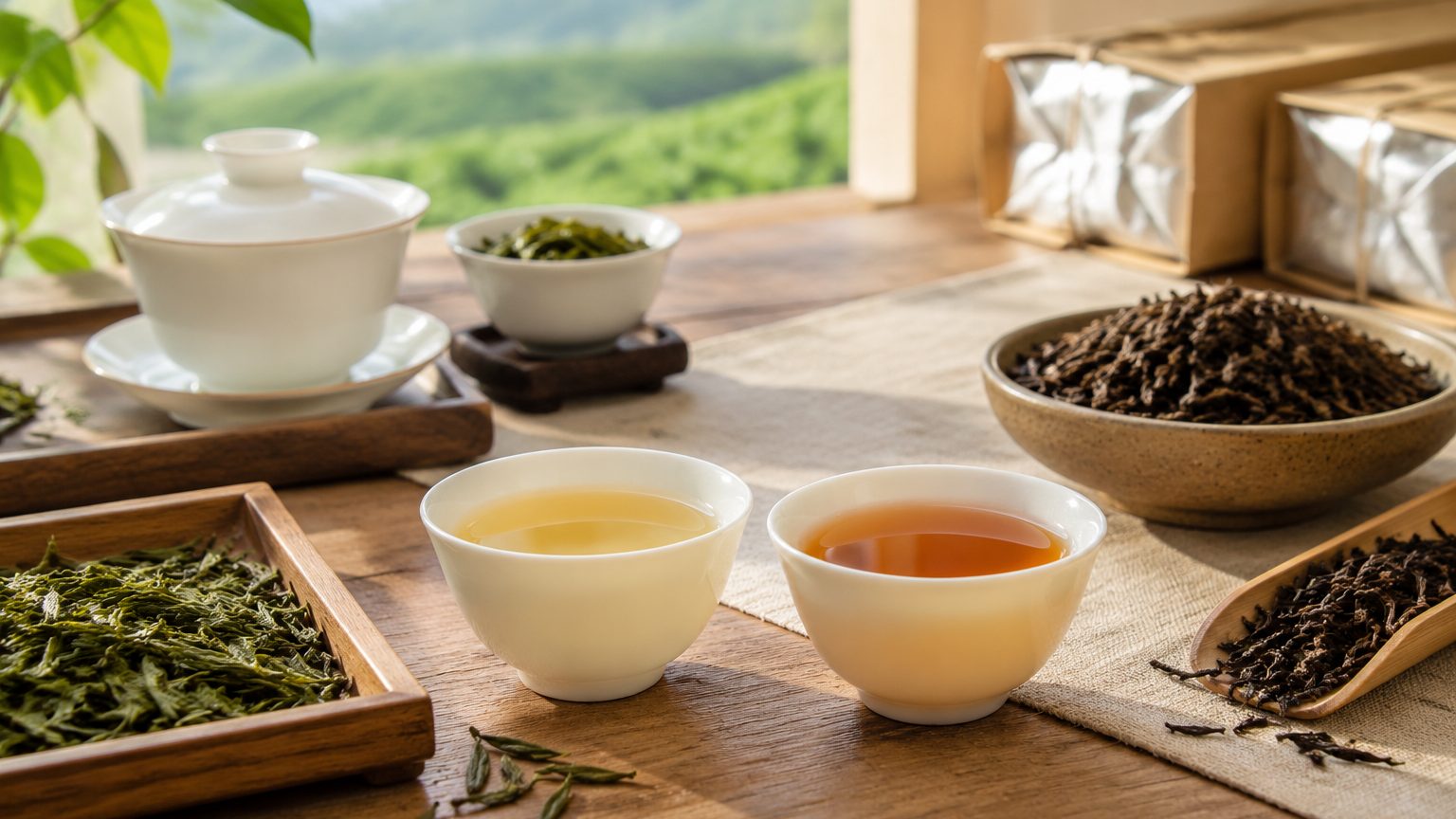
The short answer
Every true tea - green, white, oolong, black and pu-erh alike - comes from a single plant, Camellia sinensis, and the six-type classification describes how that one leaf is processed. Herbal teas are not tea in that sense at all: they are infusions of other plants - chamomile, roselle, lavender, mint, rose, roasted barley, dried fruit - and most carry no caffeine by nature. The divide matters to buyers for four practical reasons. Caffeine: true tea always has some; most herbals have none. Brewing: herbals generally take hotter water and longer steeps. Paperwork: true tea sits under the tea heading in customs nomenclature, while many botanicals are classified elsewhere. Supply: leaf follows a spring harvest calendar; botanicals largely do not. Neither side replaces the other - a complete program almost always needs both, and the herbal category page shows how the infusions sit alongside the leaf lines in one catalog.
One plant versus a pantry of plants
The tea side of the divide is disciplined: one species, and every difference between a grassy fresh longjing and an aged ripe pu-erh comes from processing - the six-type framework that organizes the whole catalog. The herbal side is a pantry. Blended infusions combine chamomile, roselle, lavender and their kin - the herbal blends line is formulated, not merely gathered. Single-ingredient peppermint shows how loud one plant can be. Rose-forward blends court the gifting shelf. Roasted barley tea - the grain infusion that anchors Korean and Japanese home drinking - is caffeine-free by nature and brews hot or cold. Fruit-based blends of dried pieces pour deep red and take to iced service without complaint. The skill on this side is recipe and raw-material consistency rather than harvest timing, which changes what a buyer should be auditing: botanical lot records and blend discipline, not leaf grades and spring windows.
Cup by cup
| Aspect | True tea | Herbal infusion |
|---|---|---|
| Raw material | Camellia sinensis leaf | Flowers, mint, grain, fruit pieces |
| Caffeine | Always present, amount varies | Mostly none by nature |
| Classification | Six types by processing | Formulated blends and singles |
| Liquor | Green to chestnut, by type | Often deep red or golden |
| Flavor logic | Leaf, cultivar, harvest | Recipe and botanical quality |
| Seasonality | Spring harvest calendar | Follows each botanical's supply |
The eye catches the divide first: fruit and roselle-forward blends pour a red most black teas never reach, while a silver needle sits at the palest end of the leaf world. For menu design that range is an asset - color and caffeine can be varied independently, which no pure-leaf wall can offer.
Brewing: hotter and longer for most botanicals
| Line | Water | Steep |
|---|---|---|
| Herbal blends | 95-100°C | About 5 min |
| Fruit blends | 100°C, or cold brew | About 5 min |
| Peppermint | 100°C | 3-5 min |
| Rose blend | 90-95°C | About 4 min |
| Barley | Boiled, or 100°C | 5-10 min |
Botanicals have no delicate leaf chemistry to scorch, so extraction wants heat and time - the frames run hotter and longer than almost any true tea, and a missed timer mostly costs strength rather than balance. Several take cold brewing happily, fruit blends especially, which makes them the easy half of any iced program. True tea runs the opposite way: each type has its own frame, and the differences between an 80°C green and a boiling black are exactly where service training goes. Write both sets of frames on the station card rather than assuming one kettle habit covers the wall.
Where each belongs on a menu
Herbal infusions own the caffeine-free slots: hotel turndown trays, evening service, wellness and gym programs, and every retail wall's decaf request - the question comes up so often that the caffeine FAQ note exists to answer it. Barley tea in particular doubles as the all-day family pitcher, hot in winter and cold in summer. Fruit blends run the iced and colorful end of the menu; rose-forward blends sell themselves in gifting. True tea carries the other jobs: the connoisseur story, the caffeine-carrying service cups, the tasting culture that brings customers back to learn. Compliance sits differently across the divide too, and buyers should treat that as part of the comparison: rules on health claims vary by market, and the labeling note draws the line a label can safely walk. Customs treatment differs as well - true tea sits under the tea heading of the tariff nomenclature while many botanicals classify elsewhere - so codes belong in a conversation with your broker, not on a blog page.
Price and supply logic
The two sides price on different engines. True tea prices on leaf: grade, origin specificity, harvest timing - with the spring window squeezing green tea availability and pricing every year. Herbal infusions price on the recipe: the cost of each botanical, the complexity of the blend, and the consistency work that keeps batch forty tasting like batch one, with sourcing spanning import and domestic channels depending on the ingredient. Seasonality smooths differently too - individual botanicals have their harvests, but a formulated blend is not hostage to one spring the way a first-flush green is. Botanical lots deserve the same batch retention habit as leaf, kept on the shelf and cupped against each new arrival. Organic channels work across both sides: certified material can be sourced per program with the certificate chain verified order by order, and the claim follows the certified material rather than the category. Reference order sizes and lead windows for both sides sit on the MOQ and lead time page, confirmed in writing per program.
Choose herbal infusions if, choose true tea if
Choose herbal infusions if the brief is caffeine-free breadth: evening and wellness menus, gifting color, iced programs that need body without bitterness, and customers who ask what is in the cup rather than where the leaf grew. Choose true tea if the brief is depth: the tasting culture, the six-type story, the service cups that anchor breakfast and afternoon, and a customer base that reads origin labels the way wine drinkers read regions. Programs with a full wall carry both and let them answer different questions - the leaf answers how, the botanicals answer what else. To plan the split across your own menu, send your concept and its constraints through the quote form: a written program proposal with samples from both sides of the divide costs nothing but the time to cup it.